Advertisements
Advertisements
Question
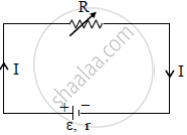
A variable resistor R is connected across a cell of emf ε and internal resistance r as shown in the figure. Draw a plot showing the variation of
(i) Terminal voltage V and
(ii) the current I, as a function of R.
Advertisements
Solution
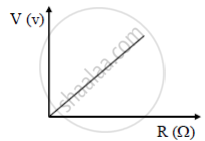
(i) Terminal voltage across a cell as a function of R
As resistance R increases current (I) in the circuit decreases and terminal voltage (V) increases.
We know V = ε –Ir; Where ε is emf of the cell
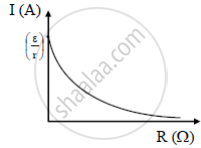
(ii) Current I as a function of R.
The current across a cell is given by `"I" = epsilon/("R"+"r")`
When R increases I decreases
APPEARS IN
RELATED QUESTIONS
Is work done by a battery always equal to the thermal energy developed in electrical circuit? What happens if a capacitor is connected in the circuit?
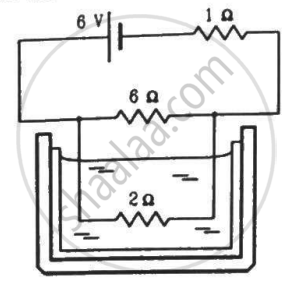
The 2.0 Ω resistor shown in the figure is dipped into a calorimeter containing water. The heat capacity of the calorimeter together with water is 2000 J K−1. (a) If the circuit is active for 15 minutes, what would be the rise in the temperature of the water? (b) Suppose the 6.0 Ω resistor gets burnt. What would be the rise in the temperature of the water in the next 15 minutes?
A carbon resistor has coloured bands as shown in Figure 2 below. The resistance of the resistor is:
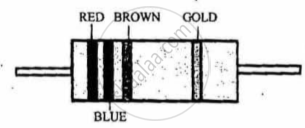
figure 2
Define temperature coefficient of resistance of the material of a conductor.
Temperature dependence of resistivity ρ(T) of semiconductors, insulators and metals is significantly based on the following factors:
- number of charge carriers can change with temperature T.
- time interval between two successive collisions can depend on T.
- length of material can be a function of T.
- mass of carriers is a function of T.
The temperature (T) dependence of resistivity of materials A and material B is represented by fig (i) and fig (ii) respectively. Identify material A and material B.
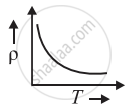 fig. (i) |
 fig. (ii) |
What does the temperature coefficient of resistivity, denoted by \(\alpha\), measure?
How is the temperature change \(\Delta T\) defined in the resistance relation?
In the microscopic relation for resistivity, what does \(n\) represent?
For metals such as copper, what is the effect of increasing temperature and the sign of \(\alpha\)?
