Advertisements
Advertisements
प्रश्न
A silver wire has a resistance of 2.1 Ω at 27.5°C, and a resistance of 2.7 Ω at 100°C. Determine the temperature coefficient of resistivity of silver.
Advertisements
उत्तर
Given: Temperature, T1 = 27.5°C
Resistance of the silver wire at T1, R1 = 2.1 Ω
Temperature, T2 = 100°C
Resistance of the silver wire at T2, R2 = 2.7 Ω
Temperature coefficient of silver = α
Formula: It is related to temperature and resistance as,
α = `(R_2 - R_1)/(R_1(T_2 - T_1))`
= `(2.7 - 2.1)/(2.1(100 - 27.5))`
= `(2.7 - 2.1)/(2.1(72.5))`
= `0.6/152.25`
= 0.0039°C−1
Therefore, the temperature coefficient of silver is 0.0039°C−1.
संबंधित प्रश्न
The order of coloured rings in a carbon resistor is red, yellow, blue and silver. The resistance of the
carbon resistor is:
a) 24 x 106 Ω ± 5%
b) 24 x 106 Ω ± 10%
c) 34 x 104 Ω ± 10%
d) 26 x 104 Ω ± 5%
The thermal energy developed in a current-carrying resistor is given by U = i2 Rt and also by U = Vit. Should we say that U is proportional to i2 or i?
Is work done by a battery always equal to the thermal energy developed in electrical circuit? What happens if a capacitor is connected in the circuit?
Two resistors R and 2R are connected in series in an electric circuit. The thermal energy developed in R and 2R are in the ratio ______________ .
The resistance of an iron wire and a copper wire at 20°C are 3.9 Ω and 4.1 Ω, respectively. At what temperature will the resistance be equal? Temperature coefficient of resistivity for iron is 5.0 × 10⁻³ K–1 and for copper, it is 4.0 × 10⁻³ K–1. Neglect any thermal expansion.
When a current passes through a resistor, its temperature increases. Is it an adiabatic process?
An electric kettle used to prepare tea, takes 2 minutes to boil 4 cups of water (1 cup contains 200 cc of water) if the room temperature is 25°C. (a) If the cost of power consumption is Re 1.00 per unit (1 unit = 1000 watt-hour), calculate the cost of boiling 4 cups of water. (b) What will be the corresponding cost if the room temperature drops to 5°C?
Find the neutral temperature and inversion temperature of a copper-iron thermocouple if the reference junction is kept at 0°C. Use the data given in the following table.
| Metal with lead (Pb) |
a `mu V"/"^oC` |
b `muV"/("^oC)` |
| Aluminium | -0.47 | 0.003 |
| Bismuth | -43.7 | -0.47 |
| Copper | 2.76 | 0.012 |
| Gold | 2.90 | 0.0093 |
| Iron | 16.6 | -0.030 |
| Nickel | 19.1 | -0.030 |
| Platinum | -1.79 | -0.035 |
| Silver | 2.50 | 0.012 |
| Steel | 10.8 | -0.016 |
Define temperature coefficient of resistance of the material of a conductor.
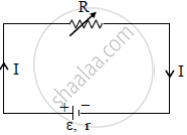
A variable resistor R is connected across a cell of emf ε and internal resistance r as shown in the figure. Draw a plot showing the variation of
(i) Terminal voltage V and
(ii) the current I, as a function of R.
Water at 10°C enters into a geyser. The water drawn out from the geyser has a temperature of 60°C and the rate of outflow of water is 18 kg/hr. The rating of the geyser is :
The temperature (T) dependence of resistivity of materials A and material B is represented by fig (i) and fig (ii) respectively. Identify material A and material B.
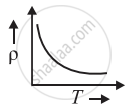 fig. (i) |
 fig. (ii) |
Which expression gives resistance at a changed temperature?
How is the temperature change \(\Delta T\) defined in the resistance relation?
In the microscopic relation for resistivity, what does \(n\) represent?
For metals such as copper, what is the effect of increasing temperature and the sign of \(\alpha\)?
