Advertisements
Advertisements
प्रश्न
At room temperature (27.0°C) the resistance of a heating element is 100 Ω. What is the temperature of the element if the resistance is found to be 117 Ω, given that the temperature coefficient of the material of the resistor is 1.70 × 10⁻⁴ °C−1.
Advertisements
उत्तर
Given: Initial temperature, T1 = 27°C
Initial resistance, R1 = 100 Ω
Let T2 is the increased temperature of the filament.
Final resistance, R2 = 117 Ω
The temperature coefficient of the material of the filament,
α = 1.70 × 10⁻⁴ °C−1
α is given by the relation,
α = `(R_2 - R_1)/(R_1(T_2 - T_1))`
`T_2 - T_1 = (R_2 - R_1)/(R_1α)`
`T_2 - 27 = (117 - 100)/(100 xx 1.7 xx 10^-4)`
`T_2 - 27 = 17/(170 xx 10^-4)`
`T_2 - 27 = 17/(0.017)`
T2 − 27 = 1000
T2 = 1000 + 27
∴ T2 = 1027°C
Therefore, at 1027°C, the resistance of the element is 117 Ω.
संबंधित प्रश्न
A heating element using nichrome connected to a 230 V supply draws an initial current of 3.2 A which settles after a few seconds to a steady value of 2.8 A. What is the steady temperature of the heating element if the room temperature is 27.0°C? The temperature coefficient of resistance of nichrome averaged over the temperature range involved is 1.70 × 10⁻⁴ °C−1.
Consider a circuit containing an ideal battery connected to a resistor. Do "work done by the battery" and "the thermal energy developed" represent two names of the same physical quantity?
A non-ideal battery is connected to a resistor. Is work done by the battery equal to the thermal energy developed in the resistor? Will your answer change if the battery is ideal?
Sometimes it is said that "heat is developed" in a resistance when there is an electric current in it. Recall that heat is defined as the energy being transferred due to temperature difference. Is the statement in quotes technically correct?
Two resistors R and 2R are connected in series in an electric circuit. The thermal energy developed in R and 2R are in the ratio ______________ .
When a current passes through a resistor, its temperature increases. Is it an adiabatic process?
Is inversion temperature always double the neutral temperature? Does the unit of temperature have an effect in deciding this question?
Is neutral temperature always the arithmetic mean of the inversion temperature and the temperature of the cold junction? Does the unit of temperature have an effect in deciding this question?
The constants a and b for the pair silver-lead are 2.50 μV°C−1 and 0.012μV°C−2, respectively. For a silver-lead thermocouple with colder junction at 0°C, ______________ .
(a) there will be no neutral temperature
(b) there will be no inversion temperature
(c) there will not be any thermo-emf even if the junctions are kept at different temperatures
(d) there will be no current in the thermocouple even if the junctions are kept at different temperatures
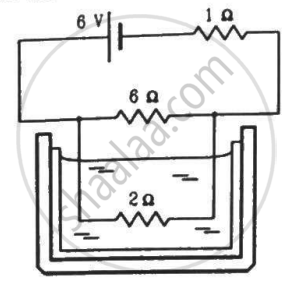
The 2.0 Ω resistor shown in the figure is dipped into a calorimeter containing water. The heat capacity of the calorimeter together with water is 2000 J K−1. (a) If the circuit is active for 15 minutes, what would be the rise in the temperature of the water? (b) Suppose the 6.0 Ω resistor gets burnt. What would be the rise in the temperature of the water in the next 15 minutes?
Find the neutral temperature and inversion temperature of a copper-iron thermocouple if the reference junction is kept at 0°C. Use the data given in the following table.
| Metal with lead (Pb) |
a `mu V"/"^oC` |
b `muV"/("^oC)` |
| Aluminium | -0.47 | 0.003 |
| Bismuth | -43.7 | -0.47 |
| Copper | 2.76 | 0.012 |
| Gold | 2.90 | 0.0093 |
| Iron | 16.6 | -0.030 |
| Nickel | 19.1 | -0.030 |
| Platinum | -1.79 | -0.035 |
| Silver | 2.50 | 0.012 |
| Steel | 10.8 | -0.016 |
A metallic wire has a resistance of 3.0 Ω at 0°C and 4.8 Ω at 150°C. Find the temperature coefficient of resistance of its material.
An electrical cable of copper has just one wire of radius 9 mm. Its resistance is 5 ohm. This single copper wire of the cable is replaced by 6 different well insulated copper wires each of radius 3 mm. The total resistance of the cable will now be equal to ______.
Water at 10°C enters into a geyser. The water drawn out from the geyser has a temperature of 60°C and the rate of outflow of water is 18 kg/hr. The rating of the geyser is :
The specific resistance of all the metals is the most affected by ______
Temperature dependence of resistivity ρ(T) of semiconductors, insulators and metals is significantly based on the following factors:
- number of charge carriers can change with temperature T.
- time interval between two successive collisions can depend on T.
- length of material can be a function of T.
- mass of carriers is a function of T.
