Advertisements
Advertisements
प्रश्न
Show variation of resistivity of Si with temperature in a graph ?
Advertisements
उत्तर
The resistivity of Silicon with temperature is shown as

APPEARS IN
संबंधित प्रश्न
Draw labelled graphs to show how electrical resistance varies with temperature for:
1) a metallic wire.
2) a piece of carbon
The thermal energy developed in a current-carrying resistor is given by U = i2 Rt and also by U = Vit. Should we say that U is proportional to i2 or i?
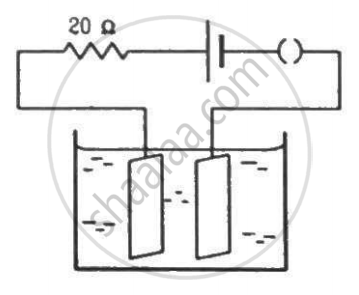
The figure shows an electrolyte of AgCl through which a current is passed. It is observed that 2.68 g of silver is deposited in 10 minutes on the cathode. Find the heat developed in the 20 Ω resistor during this period. Atomic weight of silver is 107.9 g/mol−1.
Find the thermo-emf developed in a copper-silver thermocouple when the junctions are kept at 0°C and 40°C. Use the data given in the following table.
| Metal with lead (Pb) |
a `mu V"/"^oC` |
b `muV"/("^oC)` |
| Aluminium | -0.47 | 0.003 |
| Bismuth | -43.7 | -0.47 |
| Copper | 2.76 | 0.012 |
| Gold | 2.90 | 0.0093 |
| Iron | 16.6 | -0.030 |
| Nickel | 19.1 | -0.030 |
| Platinum | -1.79 | -0.035 |
| Silver | 2.50 | 0.012 |
| Steel | 10.8 | -0.016 |
Find the neutral temperature and inversion temperature of a copper-iron thermocouple if the reference junction is kept at 0°C. Use the data given in the following table.
| Metal with lead (Pb) |
a `mu V"/"^oC` |
b `muV"/("^oC)` |
| Aluminium | -0.47 | 0.003 |
| Bismuth | -43.7 | -0.47 |
| Copper | 2.76 | 0.012 |
| Gold | 2.90 | 0.0093 |
| Iron | 16.6 | -0.030 |
| Nickel | 19.1 | -0.030 |
| Platinum | -1.79 | -0.035 |
| Silver | 2.50 | 0.012 |
| Steel | 10.8 | -0.016 |
By increasing the temperature, the specific resistance of a conductor and a semiconductor -
The specific resistance of all the metals is the most affected by ______
Which expression gives resistivity \(\rho_T\) at temperature \(T\) in terms of resistivity \(\rho_0\) at reference temperature \(T_0\)?
How is the temperature change \(\Delta T\) defined in the resistance relation?
Which linear thermometer relation is used to find the temperature \(t\) when its resistance is \(R_t\)?
