Advertisements
Advertisements
प्रश्न
Is work done by a battery always equal to the thermal energy developed in electrical circuit? What happens if a capacitor is connected in the circuit?
Advertisements
उत्तर
No, the work done by a battery is not always equal to the thermal energy developed in the electrical circuit. In case of a non-ideal battery, the work done by the battery is the sum of the thermal energy developed in the electric circuit and the thermal energy developed in the internal resistance of the battery. In case of a capacitor, the work done by the battery is equal to C V2. An amount of energy equal to `1/2` C V2 is stored in it when it is fully charged, which is a form of electrical energy and not a form of thermal energy. During the charging of the capacitor, `1/2` C V2 of energy is lost in the form of heat and electromagnetic radiation.
APPEARS IN
संबंधित प्रश्न
As the temperature of a metallic resistor is increased, the product of its resistivity and conductivity ____________ .
When a current passes through a resistor, its temperature increases. Is it an adiabatic process?
Is inversion temperature always double the neutral temperature? Does the unit of temperature have an effect in deciding this question?
Is neutral temperature always the arithmetic mean of the inversion temperature and the temperature of the cold junction? Does the unit of temperature have an effect in deciding this question?
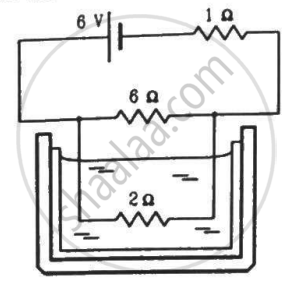
The 2.0 Ω resistor shown in the figure is dipped into a calorimeter containing water. The heat capacity of the calorimeter together with water is 2000 J K−1. (a) If the circuit is active for 15 minutes, what would be the rise in the temperature of the water? (b) Suppose the 6.0 Ω resistor gets burnt. What would be the rise in the temperature of the water in the next 15 minutes?
A carbon resistor has coloured bands as shown in Figure 2 below. The resistance of the resistor is:
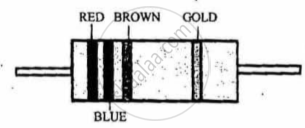
figure 2
Define temperature coefficient of resistance of the material of a conductor.
A metallic wire has a resistance of 3.0 Ω at 0°C and 4.8 Ω at 150°C. Find the temperature coefficient of resistance of its material.
An electrical cable of copper has just one wire of radius 9 mm. Its resistance is 5 ohm. This single copper wire of the cable is replaced by 6 different well insulated copper wires each of radius 3 mm. The total resistance of the cable will now be equal to ______.
The higher and lower fixed points on a thermometer are separated by 160 mm. When the length of the mercury thread above the lower point is 40 mm, the temperature reading would be :
The specific resistance of all the metals is the most affected by ______
In metals, how does resistivity usually change when temperature increases over a limited temperature range?
Which expression gives resistance at a changed temperature?
How is the temperature change \(\Delta T\) defined in the resistance relation?
Which microscopic relation for resistivity is given in terms of conductivity, electron mass, free-electron number density, electronic charge, and average relaxation time?
What happens to electron collisions and relaxation time in metals as temperature rises?
