Advertisements
Advertisements
प्रश्न
Is work done by a battery always equal to the thermal energy developed in electrical circuit? What happens if a capacitor is connected in the circuit?
Advertisements
उत्तर
No, the work done by a battery is not always equal to the thermal energy developed in the electrical circuit. In case of a non-ideal battery, the work done by the battery is the sum of the thermal energy developed in the electric circuit and the thermal energy developed in the internal resistance of the battery. In case of a capacitor, the work done by the battery is equal to C V2. An amount of energy equal to `1/2` C V2 is stored in it when it is fully charged, which is a form of electrical energy and not a form of thermal energy. During the charging of the capacitor, `1/2` C V2 of energy is lost in the form of heat and electromagnetic radiation.
APPEARS IN
संबंधित प्रश्न
A silver wire has a resistance of 2.1 Ω at 27.5°C, and a resistance of 2.7 Ω at 100°C. Determine the temperature coefficient of resistivity of silver.
Show variation of resistivity of Si with temperature in a graph ?
As the temperature of a metallic resistor is increased, the product of its resistivity and conductivity ____________ .
Two resistors R and 2R are connected in series in an electric circuit. The thermal energy developed in R and 2R are in the ratio ______________ .
The resistance of an iron wire and a copper wire at 20°C are 3.9 Ω and 4.1 Ω, respectively. At what temperature will the resistance be equal? Temperature coefficient of resistivity for iron is 5.0 × 10⁻³ K–1 and for copper, it is 4.0 × 10⁻³ K–1. Neglect any thermal expansion.
Is neutral temperature always the arithmetic mean of the inversion temperature and the temperature of the cold junction? Does the unit of temperature have an effect in deciding this question?
An electric kettle used to prepare tea, takes 2 minutes to boil 4 cups of water (1 cup contains 200 cc of water) if the room temperature is 25°C. (a) If the cost of power consumption is Re 1.00 per unit (1 unit = 1000 watt-hour), calculate the cost of boiling 4 cups of water. (b) What will be the corresponding cost if the room temperature drops to 5°C?
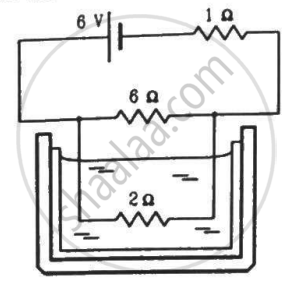
The 2.0 Ω resistor shown in the figure is dipped into a calorimeter containing water. The heat capacity of the calorimeter together with water is 2000 J K−1. (a) If the circuit is active for 15 minutes, what would be the rise in the temperature of the water? (b) Suppose the 6.0 Ω resistor gets burnt. What would be the rise in the temperature of the water in the next 15 minutes?
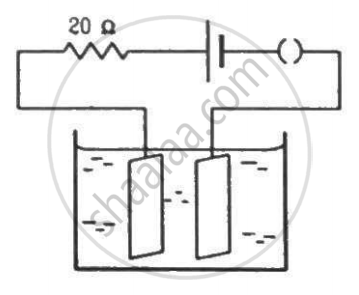
The figure shows an electrolyte of AgCl through which a current is passed. It is observed that 2.68 g of silver is deposited in 10 minutes on the cathode. Find the heat developed in the 20 Ω resistor during this period. Atomic weight of silver is 107.9 g/mol−1.
A carbon resistor has coloured bands as shown in Figure 2 below. The resistance of the resistor is:
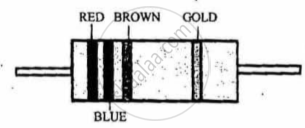
figure 2
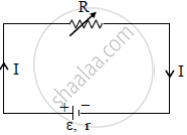
A variable resistor R is connected across a cell of emf ε and internal resistance r as shown in the figure. Draw a plot showing the variation of
(i) Terminal voltage V and
(ii) the current I, as a function of R.
An electrical cable of copper has just one wire of radius 9 mm. Its resistance is 5 ohm. This single copper wire of the cable is replaced by 6 different well insulated copper wires each of radius 3 mm. The total resistance of the cable will now be equal to ______.
Temperature dependence of resistivity ρ(T) of semiconductors, insulators and metals is significantly based on the following factors:
- number of charge carriers can change with temperature T.
- time interval between two successive collisions can depend on T.
- length of material can be a function of T.
- mass of carriers is a function of T.
In metals, how does resistivity usually change when temperature increases over a limited temperature range?
Which expression gives resistivity \(\rho_T\) at temperature \(T\) in terms of resistivity \(\rho_0\) at reference temperature \(T_0\)?
Which expression gives resistance at a changed temperature?
In the microscopic relation for resistivity, what does \(m\) represent?
For alloys such as nichrome, what is the effect of increasing temperature and the sign of \(\alpha\)?
