Advertisements
Advertisements
प्रश्न
Consider the following statements regarding a thermocouple.
(A) The neutral temperature does not depend on the temperature of the cold junction.
(B) The inversion temperature does not depend on the temperature of the cold junction.
पर्याय
A and B are correct
A is correct but B is wrong
B is correct but A is wrong
A and B are wrong
Advertisements
उत्तर
A is correct but B is wrong
The value of neutral temperature is constant for a thermocouple. It depends on the nature of materials and is independent of the temperature of the cold junction. Inversion temperature depends on the temperature of the cold junction, as well as the nature of the material.
APPEARS IN
संबंधित प्रश्न
A heating element using nichrome connected to a 230 V supply draws an initial current of 3.2 A which settles after a few seconds to a steady value of 2.8 A. What is the steady temperature of the heating element if the room temperature is 27.0°C? The temperature coefficient of resistance of nichrome averaged over the temperature range involved is 1.70 × 10⁻⁴ °C−1.
Is work done by a battery always equal to the thermal energy developed in electrical circuit? What happens if a capacitor is connected in the circuit?
When a current passes through a resistor, its temperature increases. Is it an adiabatic process?
Is neutral temperature always the arithmetic mean of the inversion temperature and the temperature of the cold junction? Does the unit of temperature have an effect in deciding this question?
As temperature increases, the viscosity of liquids decreases considerably. Will this decrease the resistance of an electrolyte as the temperature increases?
Find the thermo-emf developed in a copper-silver thermocouple when the junctions are kept at 0°C and 40°C. Use the data given in the following table.
| Metal with lead (Pb) |
a `mu V"/"^oC` |
b `muV"/("^oC)` |
| Aluminium | -0.47 | 0.003 |
| Bismuth | -43.7 | -0.47 |
| Copper | 2.76 | 0.012 |
| Gold | 2.90 | 0.0093 |
| Iron | 16.6 | -0.030 |
| Nickel | 19.1 | -0.030 |
| Platinum | -1.79 | -0.035 |
| Silver | 2.50 | 0.012 |
| Steel | 10.8 | -0.016 |
Find the neutral temperature and inversion temperature of a copper-iron thermocouple if the reference junction is kept at 0°C. Use the data given in the following table.
| Metal with lead (Pb) |
a `mu V"/"^oC` |
b `muV"/("^oC)` |
| Aluminium | -0.47 | 0.003 |
| Bismuth | -43.7 | -0.47 |
| Copper | 2.76 | 0.012 |
| Gold | 2.90 | 0.0093 |
| Iron | 16.6 | -0.030 |
| Nickel | 19.1 | -0.030 |
| Platinum | -1.79 | -0.035 |
| Silver | 2.50 | 0.012 |
| Steel | 10.8 | -0.016 |
A carbon resistor has coloured bands as shown in Figure 2 below. The resistance of the resistor is:
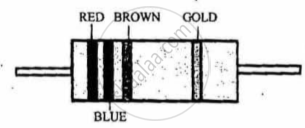
figure 2
By increasing the temperature, the specific resistance of a conductor and a semiconductor -
The temperature (T) dependence of resistivity of materials A and material B is represented by fig (i) and fig (ii) respectively. Identify material A and material B.
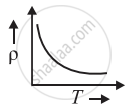 fig. (i) |
 fig. (ii) |
In metals, how does resistivity usually change when temperature increases over a limited temperature range?
Which expression gives resistivity \(\rho_T\) at temperature \(T\) in terms of resistivity \(\rho_0\) at reference temperature \(T_0\)?
Which expression gives resistance at a changed temperature?
Which microscopic relation for resistivity is given in terms of conductivity, electron mass, free-electron number density, electronic charge, and average relaxation time?
In the microscopic relation for resistivity, what does \(n\) represent?
A nichrome toaster element has a resistance of \(75.3\,\Omega\) at \(27^{\circ}\mathrm{C}\) and \(85.8\,\Omega\) at its operating temperature. If \(\alpha=1.7\times10^{-4}\,^{\circ}\mathrm{C}^{-1}\), what is the steady temperature approximately?
