Advertisements
Advertisements
प्रश्न
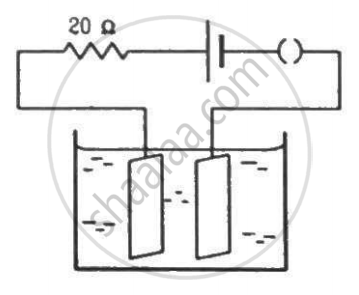
The figure shows an electrolyte of AgCl through which a current is passed. It is observed that 2.68 g of silver is deposited in 10 minutes on the cathode. Find the heat developed in the 20 Ω resistor during this period. Atomic weight of silver is 107.9 g/mol−1.
Advertisements
उत्तर
Given:-
Mass of silver deposited, m = 2.68 g
Time, t = 10 minutes = 600 s
Using the formula, m = Zit, we get:-
\[2 . 68 \times {10}^{- 3} = \frac{107 . 9 \times {10}^{- 3}}{96500} \times i \times 600\]
\[ \Rightarrow i = \frac{2 . 68 \times 96500}{107 . 9 \times 600}\]
\[ \Rightarrow i = 3 . 99 = 4 A\]
Heat developed in the 20 Ω resistor,
\[H = i^2 Rt\]
\[ \Rightarrow H = \left( 4 \right)^2 \times 20 \times 600\]
\[ \Rightarrow H = 192000 J = 192 kJ\]
APPEARS IN
संबंधित प्रश्न
At room temperature (27.0°C) the resistance of a heating element is 100 Ω. What is the temperature of the element if the resistance is found to be 117 Ω, given that the temperature coefficient of the material of the resistor is 1.70 × 10⁻⁴ °C−1.
A silver wire has a resistance of 2.1 Ω at 27.5°C, and a resistance of 2.7 Ω at 100°C. Determine the temperature coefficient of resistivity of silver.
The order of coloured rings in a carbon resistor is red, yellow, blue and silver. The resistance of the
carbon resistor is:
a) 24 x 106 Ω ± 5%
b) 24 x 106 Ω ± 10%
c) 34 x 104 Ω ± 10%
d) 26 x 104 Ω ± 5%
Draw labelled graphs to show how electrical resistance varies with temperature for:
1) a metallic wire.
2) a piece of carbon
Is inversion temperature always double the neutral temperature? Does the unit of temperature have an effect in deciding this question?
Is neutral temperature always the arithmetic mean of the inversion temperature and the temperature of the cold junction? Does the unit of temperature have an effect in deciding this question?
An electric kettle used to prepare tea, takes 2 minutes to boil 4 cups of water (1 cup contains 200 cc of water) if the room temperature is 25°C. (a) If the cost of power consumption is Re 1.00 per unit (1 unit = 1000 watt-hour), calculate the cost of boiling 4 cups of water. (b) What will be the corresponding cost if the room temperature drops to 5°C?
The higher and lower fixed points on a thermometer are separated by 160 mm. When the length of the mercury thread above the lower point is 40 mm, the temperature reading would be :
Water at 10°C enters into a geyser. The water drawn out from the geyser has a temperature of 60°C and the rate of outflow of water is 18 kg/hr. The rating of the geyser is :
Temperature dependence of resistivity ρ(T) of semiconductors, insulators and metals is significantly based on the following factors:
- number of charge carriers can change with temperature T.
- time interval between two successive collisions can depend on T.
- length of material can be a function of T.
- mass of carriers is a function of T.
What does the temperature coefficient of resistivity, denoted by \(\alpha\), measure?
Which units are given for the temperature coefficient of resistivity?
Which expression gives resistivity \(\rho_T\) at temperature \(T\) in terms of resistivity \(\rho_0\) at reference temperature \(T_0\)?
Which expression gives resistance at a changed temperature?
In the microscopic relation for resistivity, what does \(m\) represent?
A nichrome toaster element has a resistance of \(75.3\,\Omega\) at \(27^{\circ}\mathrm{C}\) and \(85.8\,\Omega\) at its operating temperature. If \(\alpha=1.7\times10^{-4}\,^{\circ}\mathrm{C}^{-1}\), what is the steady temperature approximately?
