Advertisements
Advertisements
प्रश्न
Is neutral temperature always the arithmetic mean of the inversion temperature and the temperature of the cold junction? Does the unit of temperature have an effect in deciding this question?
Advertisements
उत्तर
No, the neutral temperature is not always the arithmetic mean of the inversion temperature and the temperature of the cold junction. That is valid only when the unit of temperature is degree Celsius.
APPEARS IN
संबंधित प्रश्न
A silver wire has a resistance of 2.1 Ω at 27.5°C, and a resistance of 2.7 Ω at 100°C. Determine the temperature coefficient of resistivity of silver.
The thermal energy developed in a current-carrying resistor is given by U = i2 Rt and also by U = Vit. Should we say that U is proportional to i2 or i?
Is work done by a battery always equal to the thermal energy developed in electrical circuit? What happens if a capacitor is connected in the circuit?
Sometimes it is said that "heat is developed" in a resistance when there is an electric current in it. Recall that heat is defined as the energy being transferred due to temperature difference. Is the statement in quotes technically correct?
As the temperature of a metallic resistor is increased, the product of its resistivity and conductivity ____________ .
The resistance of an iron wire and a copper wire at 20°C are 3.9 Ω and 4.1 Ω, respectively. At what temperature will the resistance be equal? Temperature coefficient of resistivity for iron is 5.0 × 10⁻³ K–1 and for copper, it is 4.0 × 10⁻³ K–1. Neglect any thermal expansion.
Consider the following statements regarding a thermocouple.
(A) The neutral temperature does not depend on the temperature of the cold junction.
(B) The inversion temperature does not depend on the temperature of the cold junction.
The figure shows an electrolyte of AgCl through which a current is passed. It is observed that 2.68 g of silver is deposited in 10 minutes on the cathode. Find the heat developed in the 20 Ω resistor during this period. Atomic weight of silver is 107.9 g/mol−1.
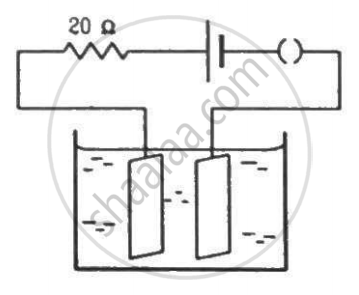
A metallic wire has a resistance of 3.0 Ω at 0°C and 4.8 Ω at 150°C. Find the temperature coefficient of resistance of its material.
By increasing the temperature, the specific resistance of a conductor and a semiconductor -
The specific resistance of all the metals is the most affected by ______
In metals, how does resistivity usually change when temperature increases over a limited temperature range?
What does the temperature coefficient of resistivity, denoted by \(\alpha\), measure?
Which microscopic relation for resistivity is given in terms of conductivity, electron mass, free-electron number density, electronic charge, and average relaxation time?
In the microscopic relation for resistivity, what does \(n\) represent?
A nichrome toaster element has a resistance of \(75.3\,\Omega\) at \(27^{\circ}\mathrm{C}\) and \(85.8\,\Omega\) at its operating temperature. If \(\alpha=1.7\times10^{-4}\,^{\circ}\mathrm{C}^{-1}\), what is the steady temperature approximately?
