Advertisements
Advertisements
प्रश्न
The thermal energy developed in a current-carrying resistor is given by U = i2 Rt and also by U = Vit. Should we say that U is proportional to i2 or i?
Advertisements
उत्तर
In the expression U = Vit, voltage V and current i are variables for a given time interval. So, based on this expression we cannot say that U is proportional to i. In the expression U = i2Rt, the resistance R is fixed for a circuit for a given time interval. So, based on this expression, we can say that U is proportional to i2 and not i.
APPEARS IN
संबंधित प्रश्न
A heating element using nichrome connected to a 230 V supply draws an initial current of 3.2 A which settles after a few seconds to a steady value of 2.8 A. What is the steady temperature of the heating element if the room temperature is 27.0°C? The temperature coefficient of resistance of nichrome averaged over the temperature range involved is 1.70 × 10⁻⁴ °C−1.
Show variation of resistivity of Si with temperature in a graph ?
Sometimes it is said that "heat is developed" in a resistance when there is an electric current in it. Recall that heat is defined as the energy being transferred due to temperature difference. Is the statement in quotes technically correct?
When a current passes through a resistor, its temperature increases. Is it an adiabatic process?
The constants a and b for the pair silver-lead are 2.50 μV°C−1 and 0.012μV°C−2, respectively. For a silver-lead thermocouple with colder junction at 0°C, ______________ .
(a) there will be no neutral temperature
(b) there will be no inversion temperature
(c) there will not be any thermo-emf even if the junctions are kept at different temperatures
(d) there will be no current in the thermocouple even if the junctions are kept at different temperatures
Find the thermo-emf developed in a copper-silver thermocouple when the junctions are kept at 0°C and 40°C. Use the data given in the following table.
| Metal with lead (Pb) |
a `mu V"/"^oC` |
b `muV"/("^oC)` |
| Aluminium | -0.47 | 0.003 |
| Bismuth | -43.7 | -0.47 |
| Copper | 2.76 | 0.012 |
| Gold | 2.90 | 0.0093 |
| Iron | 16.6 | -0.030 |
| Nickel | 19.1 | -0.030 |
| Platinum | -1.79 | -0.035 |
| Silver | 2.50 | 0.012 |
| Steel | 10.8 | -0.016 |
A carbon resistor has coloured bands as shown in Figure 2 below. The resistance of the resistor is:
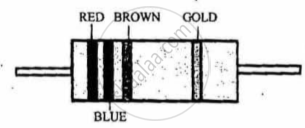
figure 2
Define temperature coefficient of resistance of the material of a conductor.
An electrical cable of copper has just one wire of radius 9 mm. Its resistance is 5 ohm. This single copper wire of the cable is replaced by 6 different well insulated copper wires each of radius 3 mm. The total resistance of the cable will now be equal to ______.
By increasing the temperature, the specific resistance of a conductor and a semiconductor -
The higher and lower fixed points on a thermometer are separated by 160 mm. When the length of the mercury thread above the lower point is 40 mm, the temperature reading would be :
The specific resistance of all the metals is the most affected by ______
The temperature (T) dependence of resistivity of materials A and material B is represented by fig (i) and fig (ii) respectively. Identify material A and material B.
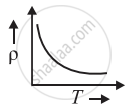 fig. (i) |
 fig. (ii) |
In metals, how does resistivity usually change when temperature increases over a limited temperature range?
What does the temperature coefficient of resistivity, denoted by \(\alpha\), measure?
In the microscopic relation for resistivity, what does \(n\) represent?
A nichrome toaster element has a resistance of \(75.3\,\Omega\) at \(27^{\circ}\mathrm{C}\) and \(85.8\,\Omega\) at its operating temperature. If \(\alpha=1.7\times10^{-4}\,^{\circ}\mathrm{C}^{-1}\), what is the steady temperature approximately?
Which linear thermometer relation is used to find the temperature \(t\) when its resistance is \(R_t\)?
