Advertisements
Advertisements
प्रश्न
Read the following paragraph and answer the questions.
|
Consider the experimental set-up shown in the figure. This jumping ring experiment is an outstanding demonstration of some simple laws of Physics. A conducting non-magnetic ring is placed over the vertical core of a solenoid. When current is passed through the solenoid, the ring is thrown off. |

- Explain the reason for the jumping of the ring when the switch is closed in the circuit.
- What will happen if the terminals of the battery are reversed and the switch is closed? Explain.
- Explain the two laws that help us understand this phenomenon.
Advertisements
उत्तर
- When a switch in a circuit is closed, current flows, causing emf in the circuit. The magnetic field of the solenoid varies continually due to ac. This causes an eddy current to form in the ring. The magnetic field produced by the induced eddy current in the ring, according to Lenz's law, opposes the changing magnetic field of the solenoid. As a result, the two magnetic fields repel one another, causing the ring to leap.
- When the switch is closed and the battery terminals are reversed, the magnetic field is reversed as well because the direction of the current is likewise reversed.
- The two laws that assist us in understanding this phenomenon are Faraday's laws and Lenz's law of electromagnetic induction.
When the induced current is applied in the same direction as the coil, the motion is countered by Lenz's law. The magnet in the loop exerts force to generate the current. To counteract the change, the magnet's current must impose a force on it.
"Whenever a conductor is placed in a varying magnetic field, an electromotive force is induced," asserts Faraday's first law of electromagnetic induction. Similarly, when the conductor circuit is closed, a current is induced, which is referred to as induced current."
APPEARS IN
संबंधित प्रश्न
State Ampere’s circuital law.
A 3.0 cm wire carrying a current of 10 A is placed inside a solenoid perpendicular to its axis. The magnetic field inside the solenoid is given to be 0.27 T. What is the magnetic force on the wire?
Two large metal sheets carry currents as shown in figure. The current through a strip of width dl is Kdl where K is a constant. Find the magnetic field at the points P, Q and R.
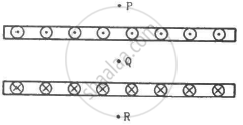
The wires which connect the battery of an automobile to its starting motor carry a current of 300 A (for a short time). What is the force per unit length between the wires if they are 70 cm long and 1.5 cm apart? Is the force attractive or repulsive?
Two identical current carrying coaxial loops, carry current I in opposite sense. A simple amperian loop passes through both of them once. Calling the loop as C, then which statement is correct?
The force required to double the length of a steel wire of area 1 cm2, if it's Young's modulus Y = `2 xx 10^11/m^2` is:
A thick current carrying cable of radius ‘R’ carries current ‘I’ uniformly distributed across its cross-section. The variation of magnetic field B(r) due to the cable with the distance ‘r’ from the axis of the cable is represented by:
A long straight wire of radius 'a' carries a steady current 'I'. The current is uniformly distributed across its area of cross-section. The ratio of the magnitude of magnetic field `vecB_1` at `a/2` and `vecB_2` at distance 2a is ______.
Which law provides a simpler alternative method for finding the magnetic field \[B\] when the current distribution has symmetry (straight wire, solenoid, toroid)?
