Advertisements
Advertisements
प्रश्न
In what respect is a toroid different from a solenoid?
Advertisements
उत्तर
Toroid
• It is a hollow circular ring on which a large number of turns of a wire are closely wound.
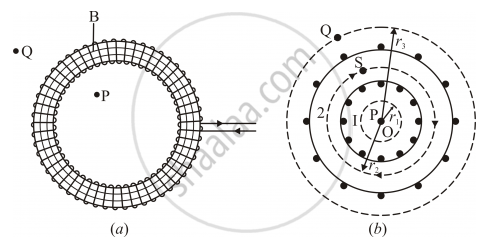
• Three Amperian loops (1, 2, and 3) are shown by dotted lines.
• Magnetic field along loop 1 is zero because the loop encloses no current.
• Magnetic field along loop 3 is zero because the current coming out of the paper is cancelled exactly by the current going out of it.
• Magnetic field at S (along loop 2):
From Ampere’s law,
∴B (2πr) = μ0NI
Where,
B → Magnetic field
r → Radius
I → Current
N → Number of turns of toroidal coil
`therefore B=(mu_0NI)/(2pir)`
APPEARS IN
संबंधित प्रश्न
Define self-inductance of a coil.
A wire AB is carrying a steady current of 10 A and is lying on the table. Another wire CD carrying 6 A is held directly above AB at a height of 2 mm. Find the mass per unit length of the wire CD so that it remains suspended at its position when left free. Give the direction of the current flowing in CD with respect to that in AB. [Take the value of g = 10 ms−2]
Draw and compare the pattern of the magnetic field lines in the two cases ?
How is the magnetic field inside a given solenoid made strong?
A circular coil of one turn of radius 5.0 cm is rotated about a diameter with a constant angular speed of 80 revolutions per minute. A uniform magnetic field B = 0.010 T exists in a direction perpendicular to the axis of rotation. Suppose the ends of the coil are connected to a resistance of 100 Ω. Neglecting the resistance of the coil, find the heat produced in the circuit in one minute.
A long solenoid is fabricated by closely winding a wire of radius 0.5 mm over a cylindrical nonmagnetic frame so that the successive turns nearly touch each other. What would be the magnetic field B at the centre of the solenoid if it carries a current of 5 A?
A tightly-wound, long solenoid is kept with its axis parallel to a large metal sheet carrying a surface current. The surface current through a width dl of the sheet is Kdl and the number of turns per unit length of the solenoid is n. The magnetic field near the centre of the solenoid is found to be zero. (a) Find the current in the solenoid. (b) If the solenoid is rotated to make its axis perpendicular to the metal sheet, what would be the magnitude of the magnetic field near its centre?
The magnetic field inside a long solenoid is given by which of the following formulas?
In the Amperian loop derivation for a solenoid, what is the contribution of side \(ab\) (inside, along the axis) to the line integral \(\oint \vec{B} \cdot d\vec{l}\)?
Solenoid valves used in washing machines and car engines serve what function?
