Advertisements
Advertisements
प्रश्न
Two identical current carrying coaxial loops, carry current I in an opposite sense. A simple amperian loop passes through both of them once. Calling the loop as C ______.
- `oint B.dl = +- 2μ_0I`
- the value of `oint B.dl` is independent of sense of C.
- there may be a point on C where B and dl are perpendicular.
- B vanishes everywhere on C.
पर्याय
a and b
a and c
b and c
c and d
Advertisements
उत्तर
b and c
Explanation:
Ampere’s law gives another method to calculate the magnetic field due to a given current distribution.
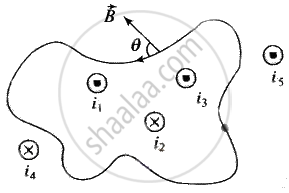
Line integral of the magnetic field `vecB` around any closed curve is equal to μ0 times the net current i threading through the area enclosed by the curve, i.e.
`oint vecB * vec(dl) = mu_0 sumi = mu_0 (i_1 + i_3 - i_2)`
Total current crossing the above area is `(i_1 + i_3 - i_2)`. Any current outside the area is not included in net current. (Outward ⊙ → + ve, Inward ⊗ → – ve)
Applying the Ampere's circuital law, we have
`ointB* dl = i_0 (I - I) = 0` (because current is in opposite sense)
Also, there may be a point on C where B and dl are perpendicular and hence, `oint_c B*dl = 0`
APPEARS IN
संबंधित प्रश्न
Explain Ampere’s circuital law.
A long straight wire of a circular cross-section of radius ‘a’ carries a steady current ‘I’. The current is uniformly distributed across the cross-section. Apply Ampere’s circuital law to calculate the magnetic field at a point ‘r’ in the region for (i) r < a and (ii) r > a.
In Ampere's \[\oint \vec{B} \cdot d \vec{l} = \mu_0 i,\] the current outside the curve is not included on the right hand side. Does it mean that the magnetic field B calculated by using Ampere's law, gives the contribution of only the currents crossing the area bounded by the curve?
A long, straight wire carries a current. Is Ampere's law valid for a loop that does not enclose the wire, or that encloses the wire but is not circular?
A thin but long, hollow, cylindrical tube of radius r carries i along its length. Find the magnitude of the magnetic field at a distance r/2 from the surface (a) inside the tube (b) outside the tube.
A long, cylindrical wire of radius b carries a current i distributed uniformly over its cross section. Find the magnitude of the magnetic field at a point inside the wire at a distance a from the axis.
A solid wire of radius 10 cm carries a current of 5.0 A distributed uniformly over its cross section. Find the magnetic field B at a point at a distance (a) 2 cm (b) 10 cm and (c) 20 cm away from the axis. Sketch a graph B versus x for 0 < x < 20 cm.
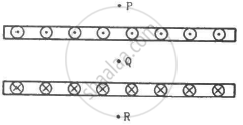
Two large metal sheets carry currents as shown in figure. The current through a strip of width dl is Kdl where K is a constant. Find the magnetic field at the points P, Q and R.
Using Ampere's circuital law, obtain an expression for the magnetic flux density 'B' at a point 'X' at a perpendicular distance 'r' from a long current-carrying conductor.
(Statement of the law is not required).
What is magnetic permeability?
Find the magnetic field due to a long straight conductor using Ampere’s circuital law.
A solenoid of length 0.6 m has a radius of 2 cm and is made up of 600 turns If it carries a current of 4 A, then the magnitude of the magnetic field inside the solenoid is:
A long solenoid having 200 turns per cm carries a current of 1.5 amp. At the centre of it is placed a coil of 100 turns of cross-sectional area 3.14 × 10⁻⁴ m2 having its axis parallel to the field produced by the solenoid. When the direction of current in the solenoid is reversed within 0.05 sec, the induced e.m.f. in the coil is:
Ampere's circuital law is used to find out ______
Two concentric and coplanar circular loops P and Q have their radii in the ratio 2:3. Loop Q carries a current 9 A in the anticlockwise direction. For the magnetic field to be zero at the common centre, loop P must carry ______.
A long straight wire of radius 'a' carries a steady current 'I'. The current is uniformly distributed across its area of cross-section. The ratio of the magnitude of magnetic field `vecB_1` at `a/2` and `vecB_2` at distance 2a is ______.
Read the following paragraph and answer the questions.
|
Consider the experimental set-up shown in the figure. This jumping ring experiment is an outstanding demonstration of some simple laws of Physics. A conducting non-magnetic ring is placed over the vertical core of a solenoid. When current is passed through the solenoid, the ring is thrown off. |

- Explain the reason for the jumping of the ring when the switch is closed in the circuit.
- What will happen if the terminals of the battery are reversed and the switch is closed? Explain.
- Explain the two laws that help us understand this phenomenon.
Magnetic fields are produced by:
Substituting \[B=\frac{\mu_0 I}{2\pi r}\] into \[\oint\vec{B}\cdot d\vec{l}=B(2\pi r)\] for a straight wire yields:
According to the right-hand rule sign convention for Ampere's law, currents flowing in the direction of the thumb are taken as ______ and currents flowing opposite to it are taken as ______.
