Advertisements
Advertisements
प्रश्न
A solid wire of radius 10 cm carries a current of 5.0 A distributed uniformly over its cross section. Find the magnetic field B at a point at a distance (a) 2 cm (b) 10 cm and (c) 20 cm away from the axis. Sketch a graph B versus x for 0 < x < 20 cm.
Advertisements
उत्तर
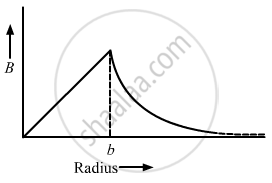
Given:
Magnitude of current, i = 5 A
Radius of the wire, b\[= 10 \text{ cm }= 10 \times {10}^{- 2}\] m
Current enclosed, \[i' = \frac{i}{\pi b^2} \times \pi a^2\]
\[B \times 2\pi a = \mu_0 \frac{i}{\pi b^2} \times \pi a^2 \]
\[ \Rightarrow B = \frac{\mu_0 ia}{2\pi b^2} \ldots\left( 1 \right)\]
\[B = \frac{4\pi \times {10}^{- 7} \times 5 \times 2 \times {10}^{- 2}}{2\pi \times {10}^{- 2}}\]
\[ = 2 \times {10}^{- 6} T = 2 \mu \] T
(b) On putting \[\text{ a = 10 cm }= 10 \times {10}^{- 2} \] m in (1), we get
B = 10 `μ T`
\[B = \frac{\mu_0 i}{2\pi a} = \frac{2 \times {10}^{- 7} \times 5}{20 \times {10}^{- 2}}\]
\[ = 5 \times {10}^{- 6} T = 5 \mu \] T
APPEARS IN
संबंधित प्रश्न
Write Maxwell's generalization of Ampere's circuital law. Show that in the process of charging a capacitor, the current produced within the plates of the capacitor is `I=varepsilon_0 (dphi_E)/dt,`where ΦE is the electric flux produced during charging of the capacitor plates.
Electron drift speed is estimated to be of the order of mm s−1. Yet large current of the order of few amperes can be set up in the wire. Explain briefly.
Using Ampere’s circuital law, obtain the expression for the magnetic field due to a long solenoid at a point inside the solenoid on its axis ?
A long, straight wire carries a current. Is Ampere's law valid for a loop that does not enclose the wire, or that encloses the wire but is not circular?
In a coaxial, straight cable, the central conductor and the outer conductor carry equal currents in opposite directions. The magnetic field is zero
(a) outside the cable
(b) inside the inner conductor
(c) inside the outer conductor
(d) in between the tow conductors.
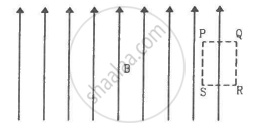
Sometimes we show an idealised magnetic field which is uniform in a given region and falls to zero abruptly. One such field is represented in figure. Using Ampere's law over the path PQRS, show that such a field is not possible.
What is magnetic permeability?
Define ampere.
Find the magnetic field due to a long straight conductor using Ampere’s circuital law.
A straight wire of diameter 0.5 mm carrying a current of 1 A is replaced by another wire of 1 mm diameter carrying the same current. The strength of the magnetic field far away is ______.
The force required to double the length of a steel wire of area 1 cm2, if it's Young's modulus Y = `2 xx 10^11/m^2` is:
A solenoid of length 0.6 m has a radius of 2 cm and is made up of 600 turns If it carries a current of 4 A, then the magnitude of the magnetic field inside the solenoid is:
A long solenoid having 200 turns per cm carries a current of 1.5 amp. At the centre of it is placed a coil of 100 turns of cross-sectional area 3.14 × 10⁻⁴ m2 having its axis parallel to the field produced by the solenoid. When the direction of current in the solenoid is reversed within 0.05 sec, the induced e.m.f. in the coil is:
A long straight wire of radius 'a' carries a steady current 'I'. The current is uniformly distributed across its area of cross-section. The ratio of the magnitude of magnetic field `vecB_1` at `a/2` and `vecB_2` at distance 2a is ______.
Briefly explain various ways to increase the strength of the magnetic field produced by a given solenoid.
Using Ampere’s circuital law, obtain an expression for magnetic flux density ‘B’ at a point near an infinitely long and straight conductor, carrying a current I.
In the sign convention for Ampere's law, if the fingers of the right hand curl along the direction of integration (\[d\vec{l}\]), the thumb points:
