Advertisements
Advertisements
प्रश्न
A solid wire of radius 10 cm carries a current of 5.0 A distributed uniformly over its cross section. Find the magnetic field B at a point at a distance (a) 2 cm (b) 10 cm and (c) 20 cm away from the axis. Sketch a graph B versus x for 0 < x < 20 cm.
Advertisements
उत्तर
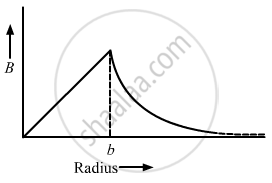
Given:
Magnitude of current, i = 5 A
Radius of the wire, b\[= 10 \text{ cm }= 10 \times {10}^{- 2}\] m
Current enclosed, \[i' = \frac{i}{\pi b^2} \times \pi a^2\]
\[B \times 2\pi a = \mu_0 \frac{i}{\pi b^2} \times \pi a^2 \]
\[ \Rightarrow B = \frac{\mu_0 ia}{2\pi b^2} \ldots\left( 1 \right)\]
\[B = \frac{4\pi \times {10}^{- 7} \times 5 \times 2 \times {10}^{- 2}}{2\pi \times {10}^{- 2}}\]
\[ = 2 \times {10}^{- 6} T = 2 \mu \] T
(b) On putting \[\text{ a = 10 cm }= 10 \times {10}^{- 2} \] m in (1), we get
B = 10 `μ T`
\[B = \frac{\mu_0 i}{2\pi a} = \frac{2 \times {10}^{- 7} \times 5}{20 \times {10}^{- 2}}\]
\[ = 5 \times {10}^{- 6} T = 5 \mu \] T
APPEARS IN
संबंधित प्रश्न
Write Maxwell's generalization of Ampere's circuital law. Show that in the process of charging a capacitor, the current produced within the plates of the capacitor is `I=varepsilon_0 (dphi_E)/dt,`where ΦE is the electric flux produced during charging of the capacitor plates.
Electron drift speed is estimated to be of the order of mm s−1. Yet large current of the order of few amperes can be set up in the wire. Explain briefly.
Using Ampere’s circuital law, obtain the expression for the magnetic field due to a long solenoid at a point inside the solenoid on its axis ?
A long, straight wire carries a current. Is Ampere's law valid for a loop that does not enclose the wire, or that encloses the wire but is not circular?
A hollow tube is carrying an electric current along its length distributed uniformly over its surface. The magnetic field
(a) increases linearly from the axis to the surface
(b) is constant inside the tube
(c) is zero at the axis
(d) is zero just outside the tube.
A thin but long, hollow, cylindrical tube of radius r carries i along its length. Find the magnitude of the magnetic field at a distance r/2 from the surface (a) inside the tube (b) outside the tube.
What is magnetic permeability?
In a capillary tube, the water rises by 1.2 mm. The height of water that will rise in another capillary tube having half the radius of the first is:
The force required to double the length of a steel wire of area 1 cm2, if it's Young's modulus Y = `2 xx 10^11/m^2` is:
Ampere's circuital law is used to find out ______
A thick current carrying cable of radius ‘R’ carries current ‘I’ uniformly distributed across its cross-section. The variation of magnetic field B(r) due to the cable with the distance ‘r’ from the axis of the cable is represented by ______
Two concentric and coplanar circular loops P and Q have their radii in the ratio 2:3. Loop Q carries a current 9 A in the anticlockwise direction. For the magnetic field to be zero at the common centre, loop P must carry ______.
A long straight wire of radius 'a' carries a steady current 'I'. The current is uniformly distributed across its area of cross-section. The ratio of the magnitude of magnetic field `vecB_1` at `a/2` and `vecB_2` at distance 2a is ______.
Using Ampere’s circuital law, obtain an expression for magnetic flux density ‘B’ at a point near an infinitely long and straight conductor, carrying a current I.
When current flowing through a solenoid decreases from 5A to 0 in 20 milliseconds, an emf of 500V is induced in it.
- What is this phenomenon called?
- Calculate coefficient of self-inductance of the solenoid.
Magnetic fields are produced by:
The SI unit of electric current, the ampere (A), is named in honour of:
According to Ampere's Circuital Law, the line integral \[\oint\vec{B}\cdot d\vec{l}\] taken around any closed loop equals:
