Advertisements
Advertisements
प्रश्न
Calculate the magnetic field inside and outside of the long solenoid using Ampere’s circuital law
Advertisements
उत्तर
- Consider a solenoid of length L having N turns.
- Solenoid’s diameter is much smaller compared to its length.
The magnetic field inside the solenoid: - Consider a rectangular loop abcd.
- From Ampere’s circuital law,
- Elemental length bc and da are perpendicular to the magnetic field.
`therefore int_"b"^"c" vec"B" * vec"dl" = int_"b"^"c" |vec"B"| vec"dl" cos 90^circ = 0`
`int_"d"^"a" vec"B" * vec"d1" = 0`
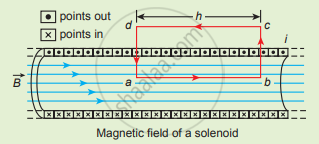
Amperian loop for solenoid
`oint_"C" vec"B" * vec"d1" = mu_0"I"_"enclosed"`
`oint_"C" vec"B"*vec"d1" = int_"a"^"b" vec"B" * vec"d1" + int_"b"^"c" vec"B"*vec"d1" + int_"c"^"d" vec"B" * vec"d1" + int_"d"^"a" vec"B" * vec"d1"`
Magnetic field outside the solenoid is zero
`int_"c"^"d" vec"B"*vec"dl" = 0`
For the path ab, `int_"a"^"b" vec"B"*vec"dl" = "B" int_"a"^"b" "dl" cos theta`
`= "B" int_"a"^"b" "dl"`
`= int_"a"^"b" vec"B" * vec"dl"` = BL
L - length of the solenoids
I - current passiing through the solenoid
N - Number of turns per unit length
`int_"a"^"b" vec"B"*vec"dl" = "BL" = mu_0"NI"`
B = `(mu_0 "NI")/"L"`
`"N"/"L" = "n"`
∴ `"N"/"L" = "n"`
∴ B = `mu_0 "nI"`
APPEARS IN
संबंधित प्रश्न
Write Maxwell's generalization of Ampere's circuital law. Show that in the process of charging a capacitor, the current produced within the plates of the capacitor is `I=varepsilon_0 (dphi_E)/dt,`where ΦE is the electric flux produced during charging of the capacitor plates.
State Ampere’s circuital law.
Electron drift speed is estimated to be of the order of mm s−1. Yet large current of the order of few amperes can be set up in the wire. Explain briefly.
A 3.0 cm wire carrying a current of 10 A is placed inside a solenoid perpendicular to its axis. The magnetic field inside the solenoid is given to be 0.27 T. What is the magnetic force on the wire?
A thin but long, hollow, cylindrical tube of radius r carries i along its length. Find the magnitude of the magnetic field at a distance r/2 from the surface (a) inside the tube (b) outside the tube.
Define ampere.
Find the magnetic field due to a long straight conductor using Ampere’s circuital law.
Which law provides a simpler alternative method for finding the magnetic field \[B\] when the current distribution has symmetry (straight wire, solenoid, toroid)?
In the sign convention for Ampere's law, if the fingers of the right hand curl along the direction of integration (\[d\vec{l}\]), the thumb points:
According to the right-hand rule sign convention for Ampere's law, currents flowing in the direction of the thumb are taken as ______ and currents flowing opposite to it are taken as ______.
