Advertisements
Advertisements
Question
A long straight wire of a circular cross-section of radius ‘a’ carries a steady current ‘I’. The current is uniformly distributed across the cross-section. Apply Ampere’s circuital law to calculate the magnetic field at a point ‘r’ in the region for (i) r < a and (ii) r > a.
Advertisements
Solution
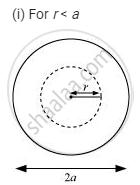
`ointvecB*vecdl = mu_0I_(enclosed)`
`(I_(enclosed))/(pia^2) = I/(pir^2)`
`I_(enclosed) = I r_2/a^2`
`vecB*vecdl = Bdl (because costheta = 1)`
`therefore ointBdl = mu_0Ir_2/a^2`
`Bointdl = mu_0Ir^2/a^2`
`B(2pir) = mu_0 Ir^2/a^2`
`B = (mu_0)/(2pi) I/a^2 r `
(ii) For r > a
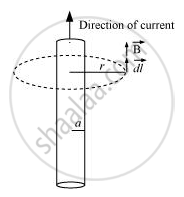
From Ampere’s circuital law,
`ointvecB*vecdl = mu_0 l_(enclosed)`
`vecB*vecdl =Bdt cos theta`
`theta = 0`
`I_(enclosed) = I`
`oint Bdl = mu_0I`
`Bointdl = mu_0I`
`B(2pir) = mu_0I`
`B= (mu_0)/(2pi) I/r`
APPEARS IN
RELATED QUESTIONS
Explain Ampere’s circuital law.
In a coaxial, straight cable, the central conductor and the outer conductor carry equal currents in opposite directions. The magnetic field is zero
(a) outside the cable
(b) inside the inner conductor
(c) inside the outer conductor
(d) in between the tow conductors.
A solid wire of radius 10 cm carries a current of 5.0 A distributed uniformly over its cross section. Find the magnetic field B at a point at a distance (a) 2 cm (b) 10 cm and (c) 20 cm away from the axis. Sketch a graph B versus x for 0 < x < 20 cm.
What is magnetic permeability?
State Ampere’s circuital law.
In a capillary tube, the water rises by 1.2 mm. The height of water that will rise in another capillary tube having half the radius of the first is:
Two identical current carrying coaxial loops, carry current I in an opposite sense. A simple amperian loop passes through both of them once. Calling the loop as C ______.
- `oint B.dl = +- 2μ_0I`
- the value of `oint B.dl` is independent of sense of C.
- there may be a point on C where B and dl are perpendicular.
- B vanishes everywhere on C.
Magnetic fields are produced by:
