Advertisements
Advertisements
प्रश्न
Consider the situation described in the previous problem. Suppose the current i enters the loop at the points A and leaves it at the point B. Find the magnetic field at the centre of the loop.
Advertisements
उत्तर
The loop ABCD can be considered as a circuit with two resistances in parallel, one along branch AB and other along branch ADC.
As, the sides of the loop are identical, their resistances are also same.
Let the resistance of each side be r.
The resistance of branch AB = r
The resistance of branch ADC = 3r
The current in the branches are calculated as:
As current follow the least resistive path so
Current in branch AB = \[\frac{3i}{4}\]
Current in branch ADC = \[\frac{i}{4}\]
At the centre of the loop:
Magnetic field due to wire AD, DC and CB will be into the plane of paper according to right hand thumb rule.
Magnetic field due to wire AB will be out of the plane of paper according to right hand thumb rule.
Net magnetic field at the centre = BAD +BDC +BCB − BAB which will be out of the plane of paper.
As, perpendicular distance of the centre from every wire will be equal to \[\frac{a}{\sqrt{2}}\] and angle made by corner points of each side at the centre is \[45^\circ \] .
\[B_{AD} = \frac{\mu_0 (\frac{i}{4})}{4\pi(\frac{a}{\sqrt{2}})}(\sin45^\circ + \sin45^\circ )\]
\[ = \frac{\mu_0 i}{8\pi a}\]
\[ B_{AD} = B_{DC} = B_{CB} \]
\[ B_{AD} + B_{DC} + B_{CB} = B^, = \frac{3 \mu_0 i}{8\pi a}\]
\[ B_{AB} = \frac{\mu_0 (\frac{3i}{4})}{4\pi(\frac{a}{\sqrt{2}})}(\sin45^\circ + \sin45^\circ )\]
\[ = \frac{3 \mu_0 i}{8\pi a}\]
\[ B_{net} = B^, - B_{AB} \]
\[ = 0\]
APPEARS IN
संबंधित प्रश्न
State Ampere’s circuital law.
State Ampere’s circuital law.
Electron drift speed is estimated to be of the order of mm s−1. Yet large current of the order of few amperes can be set up in the wire. Explain briefly.
Using Ampere’s circuital law, obtain the expression for the magnetic field due to a long solenoid at a point inside the solenoid on its axis ?
A thin but long, hollow, cylindrical tube of radius r carries i along its length. Find the magnitude of the magnetic field at a distance r/2 from the surface (a) inside the tube (b) outside the tube.
A long, cylindrical wire of radius b carries a current i distributed uniformly over its cross section. Find the magnitude of the magnetic field at a point inside the wire at a distance a from the axis.
A solid wire of radius 10 cm carries a current of 5.0 A distributed uniformly over its cross section. Find the magnetic field B at a point at a distance (a) 2 cm (b) 10 cm and (c) 20 cm away from the axis. Sketch a graph B versus x for 0 < x < 20 cm.
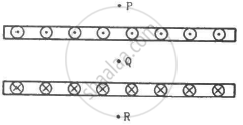
Two large metal sheets carry currents as shown in figure. The current through a strip of width dl is Kdl where K is a constant. Find the magnetic field at the points P, Q and R.
State Ampere’s circuital law.
Find the magnetic field due to a long straight conductor using Ampere’s circuital law.
Calculate the magnetic field inside and outside of the long solenoid using Ampere’s circuital law
Two identical current carrying coaxial loops, carry current I in opposite sense. A simple amperian loop passes through both of them once. Calling the loop as C, then which statement is correct?
A long solenoid having 200 turns per cm carries a current of 1.5 amp. At the centre of it is placed a coil of 100 turns of cross-sectional area 3.14 × 10⁻⁴ m2 having its axis parallel to the field produced by the solenoid. When the direction of current in the solenoid is reversed within 0.05 sec, the induced e.m.f. in the coil is:
A thick current carrying cable of radius ‘R’ carries current ‘I’ uniformly distributed across its cross-section. The variation of magnetic field B(r) due to the cable with the distance ‘r’ from the axis of the cable is represented by:
Two identical current carrying coaxial loops, carry current I in an opposite sense. A simple amperian loop passes through both of them once. Calling the loop as C ______.
- `oint B.dl = +- 2μ_0I`
- the value of `oint B.dl` is independent of sense of C.
- there may be a point on C where B and dl are perpendicular.
- B vanishes everywhere on C.
A long straight wire of radius 'a' carries a steady current 'I'. The current is uniformly distributed across its area of cross-section. The ratio of the magnitude of magnetic field `vecB_1` at `a/2` and `vecB_2` at distance 2a is ______.
Briefly explain various ways to increase the strength of the magnetic field produced by a given solenoid.
