Advertisements
Advertisements
प्रश्न
State Kirchhoff ’s voltage rule.
Advertisements
उत्तर
It states that in a closed circuit the algebraic sum of the products of the current and resistance of each part of the circuit is equal to the total emf included in the circuit. This rule follows from the law of conservation of energy for an isolated system.
APPEARS IN
संबंधित प्रश्न
Determine the current in each branch of the network shown in figure.
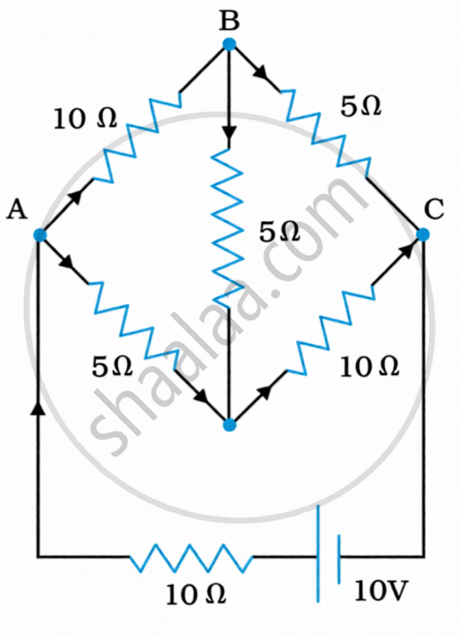
Given the resistances of 1 Ω, 2 Ω, 3 Ω, how will be combine them to get an equivalent resistance of (11/3) Ω?
Given the resistances of 1 Ω, 2 Ω, 3 Ω, how will be combine them to get an equivalent resistance of (11/5) Ω?
Given the resistances of 1 Ω, 2 Ω, 3 Ω, how will be combine them to get an equivalent resistance of 6 Ω?
On which conservation principle is Kirchoff's Second Law of electrical networks based?
In the circuit shown in the figure below, E1 and E2 are two cells having emfs 2 V and 3 V respectively, and negligible internal resistance. Applying Kirchhoff’s laws of electrical networks, find the values of currents l1 and I2.

Two cell of 1.25 V and 0.75 V are connected parallel. The effective voltage will be:-
Which mathematical form represents Kirchhoff's Current Law using an algebraic sum of currents?
Which term is defined as the rate of flow of charge through a conductor?
What is the sign of the emf when moving from the negative terminal to the positive terminal of a cell?
