Advertisements
Advertisements
Question
Why are alloys used for making standard resistance coils?
Advertisements
Solution
Alloys are used for making standard resistance coil because they have low-temperature coefficient of resistance with less temperature sensitivity.

This keeps the resistance of the wire almost constant even in small temperature change. The alloys also have high resistivity and hence high resistance, because for given length and cross-section area of conductor (L and A are constant). R α p
APPEARS IN
RELATED QUESTIONS
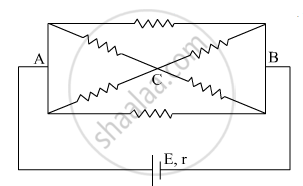
The current is drawn from a cell of emf E and internal resistance r connected to the network of resistors each of resistance r as shown in the figure. Obtain the expression for
- the current draw from the cell and
- the power consumed in the network.
State Kirchhoff's rules and explain on what basis they are justified.
Given the resistances of 1 Ω, 2 Ω, 3 Ω, how will be combine them to get an equivalent resistance of 6 Ω?
Given the resistances of 1 Ω, 2 Ω, 3 Ω, how will be combine them to get an equivalent resistance of (6/11) Ω?
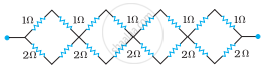
Determine the equivalent resistance of networks shown in Fig.
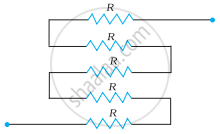
Determine the equivalent resistance of networks shown in Fig.
State Kirchhoff's rules for an electric network. Using Kirchhoff's rules, obtain the balance condition in terms of the resistances of four arms of Wheatstone bridge.
Calculate the value of the resistance R in the circuit shown in the figure so that the current in the circuit is 0.2 A. What would b the potential difference between points B and E?

In the given circuit, assuming point A to be at zero potential, use Kirchhoff’s rules to determine the potential at point B.

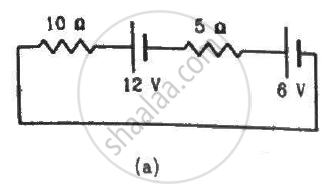
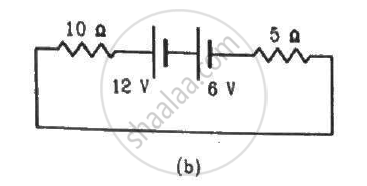
Consider the circuit shown in the figure. Find (a) the current in the circuit (b) the potential drop across the 5 Ω resistor (c) the potential drop across the 10 Ω resistor (d) Answer the parts (a), (b) and (c) with reference to the figure.
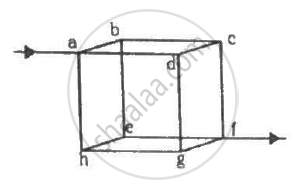
Twelve wires, each of equal resistance r, are joined to form a cube, as shown in the figure. Find the equivalent resistance between the diagonally-opposite points a and f.
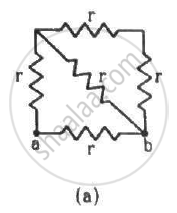
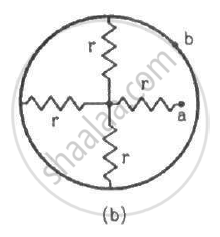
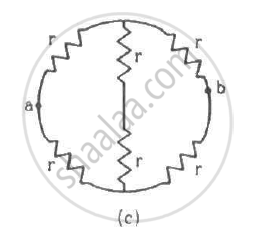
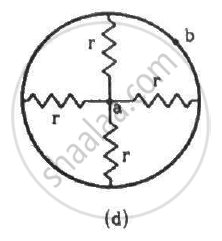
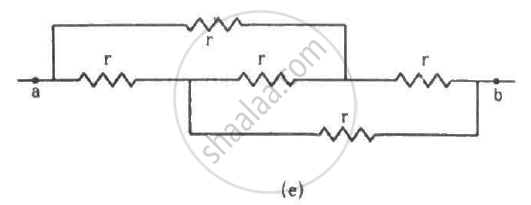
Find the equivalent resistances of the networks shown in the figure between the points a and b.
A capacitor of capacitance 8.0 μF is connected to a battery of emf 6.0 V through a resistance of 24 Ω. Find the current in the circuit (a) just after the connections are made and (b) one time constant after the connections are made.
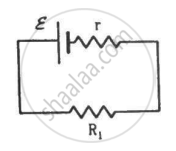
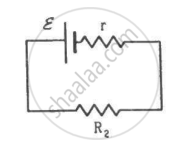
Two unequal resistances, R1 and R2, are connected across two identical batteries of emf ε and internal resistance r (see the figure). Can the thermal energies developed in R1 and R2 be equal in a given time? If yes, what will be the condition?
Twelve wires each having a resistance of 3 Ω are connected to form a cubical network. A battery of 10 V and negligible internal resistance is connected across the diagonally opposite corners of this network. Determine its equivalent resistance and the current along each edge of the cube.
State Kirchhoff ’s voltage rule.
State the principle of potentiometer.
Obtain the condition for bridge balance in Wheatstone’s bridge.
Explain the determination of unknown resistance using meter bridge.
In a potentiometer arrangement, a cell of emf 1.25 V gives a balance point at 35 cm length of the wire. If the cell is replaced by another cell and the balance point shifts to 63 cm, what is the emf of the second cell?
Kirchhoff’s second law is a consequence of law of conservation of ______.
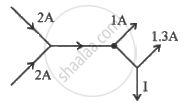
The figure below shows current in a part of electric circuit. The current I is ______.
Kirchhoff s second law is based on the law of conservation of ______
In a meter bridge the point D is a neutral point (Figure).
- The meter bridge can have no other neutral point for this set of resistances.
- When the jockey contacts a point on meter wire left of D, current flows to B from the wire.
- When the jockey contacts a point on the meter wire to the right of D, current flows from B to the wire through galvanometer.
- When R is increased, the neutral point shifts to left.
Derive the equation of the balanced state in a Wheatstone bridge using Kirchhoff’s laws.
A 6-volt battery is connected to the terminals of a three-metre-long wire of uniform thickness and resistance of 100 ohms. The difference of potential between two points on the wire separated by a distance of 50 cm will be ______.
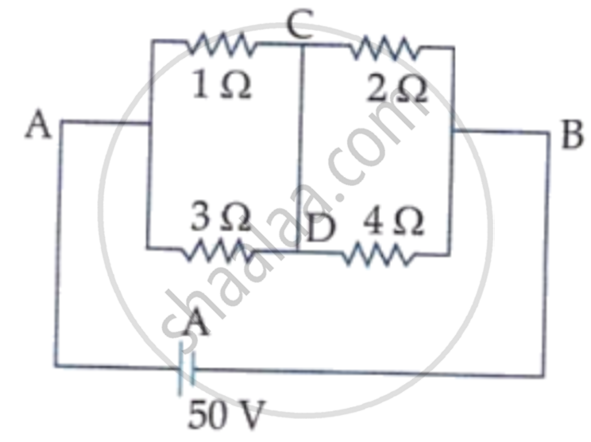
A constant voltage of 50 V is maintained between the points A and B of the circuit shown in the figure. The current through the branch CD of the circuit is:
Which two basic physical principles form the basis of Kirchhoff's laws?
At any junction, what does Kirchhoff's Current Law state?
Which mathematical form represents Kirchhoff's Current Law using an algebraic sum of currents?
Which pair of equations expresses the loop relationship for cells and resistors?
Why must the amount of charge entering a junction per second equal the amount leaving when current is steady?
In a closed loop containing cells and resistors, what equals the total potential drop across the resistors?
Which sign convention is usually used for current entering a junction?
Which sign convention is usually used for current leaving a junction?
At junction P, currents \[0.2\,\mathrm{A}\], \[0.6\,\mathrm{A}\], and \[0.7\,\mathrm{A}\] point towards P, while \[0.4\,\mathrm{A}\], \[0.5\,\mathrm{A}\], and \[I\] point away. What is the unknown current?
