Advertisements
Advertisements
प्रश्न
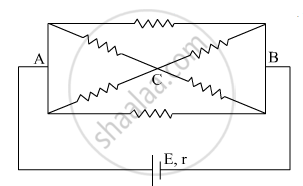
The current is drawn from a cell of emf E and internal resistance r connected to the network of resistors each of resistance r as shown in the figure. Obtain the expression for
- the current draw from the cell and
- the power consumed in the network.
Advertisements
उत्तर
From the above figure we can use the horizontal symmetry to deduce the current.
As both resistance in the circuit as well as the internal resistance in the circuit have the same resistance 'r'
The resistance of the loop I will be
`1/R_I=1/r+1/(2r)`
`1/R_I=(3r)/(2r^2)`
`R_I=(2r)/3`
Because the circuit I and II are same we can say
RII=(2r)/3
Combined resistance will be
R = RI + RII
`1/R=1/R_(I)+1/R_(II)`
`1/R=1/((2r)/3)+1/((2r)/3)`
`1/R=2×(1/((2r)/3))`
`R=r/3`
Now this circuit is series with internal resistance 'r'
Resultant resistance will be
`R_("resultant")=(4r)/3`
The current drawn from the cell will be
`I=(3E)/(4r)`
And power consumed by the network
`P=I^2/R`
`P=(9E^2)/(16r^2)×(4r)/3`
`P=(3E^2)/(4r)`
APPEARS IN
संबंधित प्रश्न
Given n resistors each of resistance R, how will you combine them to get the (i) maximum (ii) minimum effective resistance? What is the ratio of the maximum to minimum resistance?
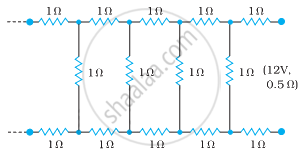
Determine the current drawn from a 12 V supply with internal resistance 0.5 Ω by the infinite network shown in the figure. Each resistor has 1 Ω resistance.
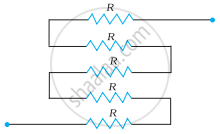
Determine the equivalent resistance of networks shown in Fig.
Calculate the value of the resistance R in the circuit shown in the figure so that the current in the circuit is 0.2 A. What would b the potential difference between points A and B?

In the given circuit, assuming point A to be at zero potential, use Kirchhoff’s rules to determine the potential at point B.

Consider the following two statements:-
(A) Kirchhoff's junction law follows from conservation of charge.
(B) Kirchhoff's loop law follows from conservative nature of electric field.
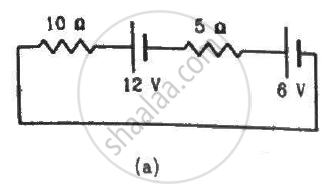
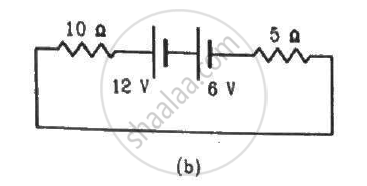
Consider the circuit shown in the figure. Find (a) the current in the circuit (b) the potential drop across the 5 Ω resistor (c) the potential drop across the 10 Ω resistor (d) Answer the parts (a), (b) and (c) with reference to the figure.
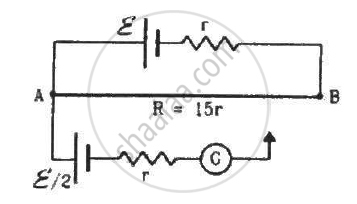
Consider the potentiometer circuit as arranged in the figure. The potentiometer wire is 600 cm long. (a) At what distance from the point A should the jockey touch the wire to get zero deflection in the galvanometer? (b) If the jockey touches the wire at a distance of 560 cm from A, what will be the current in the galvanometer?
A copper wire of 10-6 m2 area of cross-section, carries a current of 2 A. If the number of electrons per cubic meter is 8 × 1028, calculate the current density and average drift velocity.
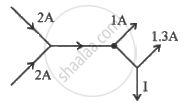
Figure shows current in a part of an electrical circuit. Then current I is ______.

Two cell of 1.25 V and 0.75 V are connected parallel. The effective voltage will be:-
The figure below shows current in a part of electric circuit. The current I is ______.
Power P is to be delivered to a device via transmission cables having resistance RC. If V is the voltage across R and I the current through it, find the power wasted and how can it be reduced.
At any junction, what does Kirchhoff's Current Law state?
What is Kirchhoff's Voltage Law also called?
Which term is defined as the rate of flow of charge through a conductor?
Why must the amount of charge entering a junction per second equal the amount leaving when current is steady?
After a charge completes one full loop and returns to its starting point, what is the net change in potential?
At junction P, currents \[0.2\,\mathrm{A}\], \[0.6\,\mathrm{A}\], and \[0.7\,\mathrm{A}\] point towards P, while \[0.4\,\mathrm{A}\], \[0.5\,\mathrm{A}\], and \[I\] point away. What is the unknown current?
