Advertisements
Advertisements
प्रश्न
Draw a sketch of equipotential surfaces due to a single charge (-q), depicting the electric field lines due to the charge
Advertisements
उत्तर
Equipotential surface for a negative charge:

APPEARS IN
संबंधित प्रश्न
Define an equipotential surface.
A man fixes outside his house one evening a two metre high insulating slab carrying on its top a large aluminium sheet of area 1 m2. Will he get an electric shock if he touches the metal sheet next morning?
Draw equipotential surfaces:
(1) in the case of a single point charge and
(2) in a constant electric field in Z-direction. Why are the equipotential surfaces about a single charge not equidistant?
(3) Can electric field exist tangential to an equipotential surface? Give reason
The diagrams below show regions of equipotentials.
(i)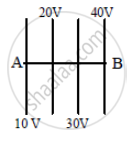 |
(ii) |
(iii)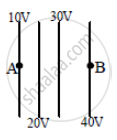 |
(iv)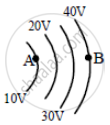 |
A positive charge is moved from A to B in each diagram.
Which of the following is NOT the property of equipotential surface?
Consider a uniform electric field in the ẑ direction. The potential is a constant ______.
- in all space.
- for any x for a given z.
- for any y for a given z.
- on the x-y plane for a given z.
In the hierarchy of equipotential concepts, which term describes a volume enclosed at the same potential?
If the electric field \[\vec{E}\] had a component along (tangent to) an equipotential surface, what contradiction would arise?
The surface of any conductor in electrostatic equilibrium is an equipotential surface because:
For an infinite line charge (infinite cylinder configuration), the equipotential surfaces are:
