Advertisements
Advertisements
प्रश्न
Two identical point charges, q each, are kept 2m apart in the air. A third point charge Q of unknown magnitude and sign is placed on the line joining the charges such that the system remains in equilibrium. Find the position and nature of Q.
Advertisements
उत्तर
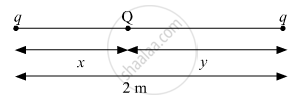
`(K(q)(Q))/x = (-K(q)(q))/2`
⇒ Q = `(-qx)/2`
∵ `(KqQ)/x = (KQq)/y`
x = y
x + y = 2
∴ x = y = 1
Q = `(-q)/2`
संबंधित प्रश्न
A regular hexagon of side 10 cm has a charge 5 µC at each of its vertices. Calculate the potential at the centre of the hexagon.
Draw equipotential surfaces:
(1) in the case of a single point charge and
(2) in a constant electric field in Z-direction. Why are the equipotential surfaces about a single charge not equidistant?
(3) Can electric field exist tangential to an equipotential surface? Give reason
Draw the equipotential surfaces due to an electric dipole. Locate the points where the potential due to the dipole is zero.
Depict the equipotential surfaces for a system of two identical positive point charges placed a distance(d) apart?
Consider the following statements and select the correct statement(s).
- Electric field lines are always perpendicular to equipotential surface.
- No two equipotential surfaces can intersect each other.
- Electric field lines are in the direction of tangent to an equipotential surface.
Which of the following is NOT the property of equipotential surface?
A curve connecting points that all have equal electric potential is best described as:
What is the shape of the equipotential surfaces for a single point charge (+q)?
The relation between the electric field \[\vec{E}\] and the potential gradient is expressed as:
