Advertisements
Advertisements
Question
Two identical point charges, q each, are kept 2m apart in the air. A third point charge Q of unknown magnitude and sign is placed on the line joining the charges such that the system remains in equilibrium. Find the position and nature of Q.
Advertisements
Solution
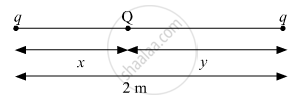
`(K(q)(Q))/x = (-K(q)(q))/2`
⇒ Q = `(-qx)/2`
∵ `(KqQ)/x = (KQq)/y`
x = y
x + y = 2
∴ x = y = 1
Q = `(-q)/2`
RELATED QUESTIONS
Two charges 2 μC and −2 µC are placed at points A and B 6 cm apart.
- Identify an equipotential surface of the system.
- What is the direction of the electric field at every point on this surface?
A man fixes outside his house one evening a two metre high insulating slab carrying on its top a large aluminium sheet of area 1 m2. Will he get an electric shock if he touches the metal sheet next morning?
Draw the equipotential surfaces due to an electric dipole. Locate the points where the potential due to the dipole is zero.
Write two important characteristics of equipotential surfaces.
Assertion: Electric field is discontinuous across the surface of a spherical charged shell.
Reason: Electric potential is continuous across the surface of a spherical charged shell.
Equipotential surfaces ______.
The work done to move a charge along an equipotential from A to B ______.
- cannot be defined as `- int_A^B E.dl`
- must be defined as `- int_A^B E.dl`
- is zero.
- can have a non-zero value.
Find the equation of the equipotentials for an infinite cylinder of radius r0, carrying charge of linear density λ.
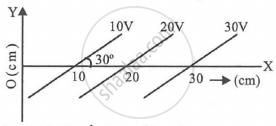
Equipotential surfaces are shown in figure. Then the electric field strength will be ______.