Advertisements
Advertisements
Question
Depict the equipotential surfaces for a system of two identical positive point charges placed a distance(d) apart?
Advertisements
Solution
An equipotential surface is a surface with a constant value of the potential at all points on the surface.
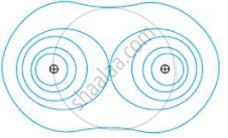
Equipotential surfaces for two identical positive charges.
APPEARS IN
RELATED QUESTIONS
What is the geometrical shape of equipotential surfaces due to a single isolated charge?
Draw the equipotential surfaces due to an electric dipole. Locate the points where the potential due to the dipole is zero.
Draw the equipotential surfaces due to an electric dipole.
Find the amount of work done in rotating an electric dipole of dipole moment 3.2 x 10- 8Cm from its position of stable equilibrium to the position of unstable equilibrium in a uniform electric field if intensity 104 N/C.
The diagrams below show regions of equipotentials.
(i)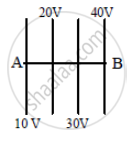 |
(ii) |
(iii)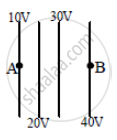 |
(iv)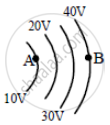 |
A positive charge is moved from A to B in each diagram.
- The potential at all the points on an equipotential surface is same.
- Equipotential surfaces never intersect each other.
- Work done in moving a charge from one point to other on an equipotential surface is zero.
Consider a uniform electric field in the ẑ direction. The potential is a constant ______.
- in all space.
- for any x for a given z.
- for any y for a given z.
- on the x-y plane for a given z.
Draw equipotential surfaces for (i) an electric dipole and (ii) two identical positive charges placed near each other.
What is meant by an equipotential surface?
