Advertisements
Advertisements
Question
A heavy nucleus X of mass number 240 and binding energy per nucleon 7.6 MeV is split into two fragments Y and Z of mass numbers 110 and 130. The binding energy of nucleons in Y and Z is 8.5 MeV per nucleon. Calculate the energy Q released per fission in MeV.
Advertisements
Solution
Total energy of nucleus X = 240 × 7.6 = 1824 MeV
Total energy of nucleus Y = 110 × 8.5 = 935 MeV
Total energy of nucleus Z = 130 × 8.5 = 1105 MeV
Therefore, energy released from fission, Q = 935 + 1105 − 1824 = 216 MeV
APPEARS IN
RELATED QUESTIONS
Asha's mother read an article in the newspaper about a disaster that took place at Chernobyl. She could not understand much from the articles and asked a few questions from Asha regarding the article. Asha tried to answer her mother's questions based on what she learnt in Class XII Physics.
(a) What was the installation at Chernobyl where the disaster took place? What according to you, was the cause of this disaster?
(b) Explain the process of release of energy in the installation at Chernobyl.
(c) What according to you, were the values displayed by Asha and her mother?
Write the relationship between the size of a nucleus and its mass number (A)?
As the mass number A increases, the binding energy per nucleon in a nucleus
Which of the following is a wrong description of binding energy of a nucleus?
Assume that the mass of a nucleus is approximately given by M = Amp where A is the mass number. Estimate the density of matter in kgm−3 inside a nucleus. What is the specific gravity of nuclear matter?
(a) Calculate the energy released if 238U emits an α-particle. (b) Calculate the energy to be supplied to 238U it two protons and two neutrons are to be emitted one by one. The atomic masses of 238U, 234Th and 4He are 238.0508 u, 234.04363 u and 4.00260 u respectively.
(Use Mass of proton mp = 1.007276 u, Mass of `""_1^1"H"` atom = 1.007825 u, Mass of neutron mn = 1.008665 u, Mass of electron = 0.0005486 u ≈ 511 keV/c2,1 u = 931 MeV/c2.)
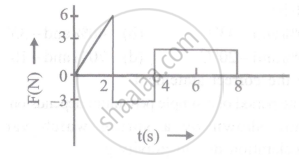
The force 'F' acting on a particle of mass 'm' is indicated by the force-time graph shown below. The change in momentum of the particle over the time interval from zero to 8s is:
The ratio of wavelengths of the last line of Balmer series and the last line of Lyman series is:
Before the advent of the theory of special relativity, what was the presumption regarding mass and energy in a reaction?
In the relation \[E = mc^2\], the quantity E represents:
