Advertisements
Advertisements
Question
The work done to move a charge along an equipotential from A to B ______.
- cannot be defined as `- int_A^B E.dl`
- must be defined as `- int_A^B E.dl`
- is zero.
- can have a non-zero value.
Options
a and b
b and c
c and d
a and c
Advertisements
Solution
b and c
Explanation:
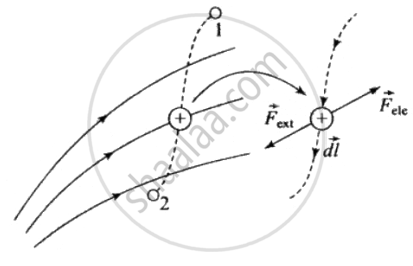
The work done by the external agent in shifting the test charge along the dashed line from 1 to 2 is
|
The external agent does a work `W = - q int_1^2 vecE * vec(dl)` in transporting the test charge q slowly from the positions 1 to 2 in the static electric field. |
`W_("ext") = int_1^2 vecF_("ext") * vec(dl) int_1^2 (-qvecE) * vec(dl) = - q int_1^2 vecE * vec(dl)`
We know `V_A - V_B = - int_A^B vecE * vec(dl)` ......(i)
`W_("electrical") = -ΔU = - qΔV = q(V_A - V_B)` ......(ii)
Hence from (i) and (ii), `W_("electrical") = q(V_A - V_B) = - qint_A^B vecE * vec(dl)`
If we want to calculate the work done to move a charge along an equipotential from A to B
For equipotential surface VA = VB, hence W = 0
Also electric field is perpendicular to equipotential surface, hence `vecE * vec(dl) => W_("electrical") = 0`
APPEARS IN
RELATED QUESTIONS
Draw equipotential surfaces:
(1) in the case of a single point charge and
(2) in a constant electric field in Z-direction. Why are the equipotential surfaces about a single charge not equidistant?
(3) Can electric field exist tangential to an equipotential surface? Give reason
What is the geometrical shape of equipotential surfaces due to a single isolated charge?
Draw the equipotential surfaces due to an electric dipole. Locate the points where the potential due to the dipole is zero.
Why is there no work done in moving a charge from one point to another on an equipotential surface?
Depict the equipotential surfaces for a system of two identical positive point charges placed a distance(d) apart?
Depict the equipotential surface due to
(i) an electric dipole,
(ii) two identical positive charges separated by a distance.
Write two important characteristics of equipotential surfaces.
Statement - 1: For practical purpose, the earth is used as a reference at zero potential in electrical circuits.
Statement - 2: The electrical potential of a sphere of radius R with charge Q uniformly distributed on the surface is given by `Q/(4piepsilon_0R)`.
Consider the following statements and select the correct statement(s).
- Electric field lines are always perpendicular to equipotential surface.
- No two equipotential surfaces can intersect each other.
- Electric field lines are in the direction of tangent to an equipotential surface.
- The potential at all the points on an equipotential surface is same.
- Equipotential surfaces never intersect each other.
- Work done in moving a charge from one point to other on an equipotential surface is zero.
Which of the following is NOT the property of equipotential surface?
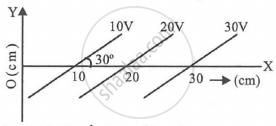
Equipotential surfaces are shown in figure. Then the electric field strength will be ______.
What is meant by an equipotential surface?
What is an equipotential surface?
Equipotential surfaces are denser (closer together) in regions where:
The relation between the electric field \[\vec{E}\] and the potential gradient is expressed as:
A particle floats between two parallel plates separated by 0.1 m with a potential difference of 4000 V. The particle carries a charge of \[1.6 \times 10^{-19}\] C. Taking \[g = 9.8\ \text{m/s}^2\], the mass of the particle is approximately:
