Advertisements
Advertisements
प्रश्न
The work done to move a charge along an equipotential from A to B ______.
- cannot be defined as `- int_A^B E.dl`
- must be defined as `- int_A^B E.dl`
- is zero.
- can have a non-zero value.
विकल्प
a and b
b and c
c and d
a and c
Advertisements
उत्तर
b and c
Explanation:
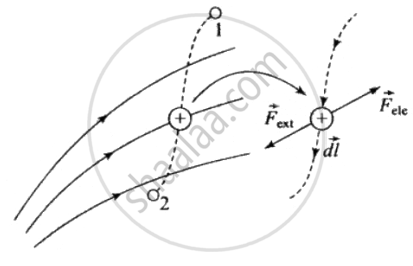
The work done by the external agent in shifting the test charge along the dashed line from 1 to 2 is
|
The external agent does a work `W = - q int_1^2 vecE * vec(dl)` in transporting the test charge q slowly from the positions 1 to 2 in the static electric field. |
`W_("ext") = int_1^2 vecF_("ext") * vec(dl) int_1^2 (-qvecE) * vec(dl) = - q int_1^2 vecE * vec(dl)`
We know `V_A - V_B = - int_A^B vecE * vec(dl)` ......(i)
`W_("electrical") = -ΔU = - qΔV = q(V_A - V_B)` ......(ii)
Hence from (i) and (ii), `W_("electrical") = q(V_A - V_B) = - qint_A^B vecE * vec(dl)`
If we want to calculate the work done to move a charge along an equipotential from A to B
For equipotential surface VA = VB, hence W = 0
Also electric field is perpendicular to equipotential surface, hence `vecE * vec(dl) => W_("electrical") = 0`
APPEARS IN
संबंधित प्रश्न
Define an equipotential surface.
A regular hexagon of side 10 cm has a charge 5 µC at each of its vertices. Calculate the potential at the centre of the hexagon.
A man fixes outside his house one evening a two metre high insulating slab carrying on its top a large aluminium sheet of area 1 m2. Will he get an electric shock if he touches the metal sheet next morning?
Depict the equipotential surfaces for a system of two identical positive point charges placed a distance(d) apart?
Draw the equipotential surfaces due to an electric dipole.
Consider the following statements and select the correct statement(s).
- Electric field lines are always perpendicular to equipotential surface.
- No two equipotential surfaces can intersect each other.
- Electric field lines are in the direction of tangent to an equipotential surface.
The diagrams below show regions of equipotentials.
(i)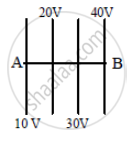 |
(ii)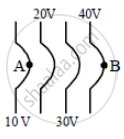 |
(iii)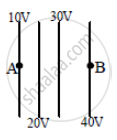 |
(iv)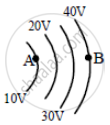 |
A positive charge is moved from A to B in each diagram.
- The potential at all the points on an equipotential surface is same.
- Equipotential surfaces never intersect each other.
- Work done in moving a charge from one point to other on an equipotential surface is zero.
Which of the following is NOT the property of equipotential surface?
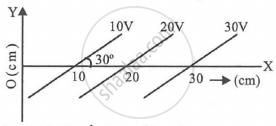
Equipotential surfaces are shown in figure. Then the electric field strength will be ______.
What is meant by an equipotential surface?
In the hierarchy of equipotential concepts, which term describes a volume enclosed at the same potential?
A charge \[q_0\] is moved from point A to point B on the same equipotential surface. If the potentials at A and B are \[V_A\] and \[V_B\] respectively, the work done is:
If the electric field \[\vec{E}\] had a component along (tangent to) an equipotential surface, what contradiction would arise?
In a uniform electric field, the equipotential surfaces take the shape of:
In the derivation proving \[\vec{E}\] is perpendicular to an equipotential surface, a charge \[q_0\] undergoes a small displacement \[d\vec{l}\] along the surface, with \[\vec{E}\] making an angle \[\theta\] with the displacement. Equating the work expressions leads to which conclusion?
The relation between the electric field \[\vec{E}\] and the potential gradient is expressed as:
A particle floats between two parallel plates separated by 0.1 m with a potential difference of 4000 V. The particle carries a charge of \[1.6 \times 10^{-19}\] C. Taking \[g = 9.8\ \text{m/s}^2\], the mass of the particle is approximately:
