Advertisements
Advertisements
प्रश्न
A man fixes outside his house one evening a two metre high insulating slab carrying on its top a large aluminium sheet of area 1 m2. Will he get an electric shock if he touches the metal sheet next morning?
Advertisements
उत्तर
Yes, the man will get an electric shock if he touches the metal slab next morning. The steady discharging current in the atmosphere charges up the aluminium sheet. As a result, its voltage rises gradually. The rise in the voltage depends on the capacitance of the capacitor formed by the aluminium slab and the ground.
APPEARS IN
संबंधित प्रश्न
The discharging current in the atmosphere due to the small conductivity of air is known to be 1800 A on an average over the globe. Why then does the atmosphere not discharge itself completely in due course and become electrically neutral? In other words, what keeps the atmosphere charged?
What is the geometrical shape of equipotential surfaces due to a single isolated charge?
Draw the equipotential surfaces due to an electric dipole. Locate the points where the potential due to the dipole is zero.
Depict the equipotential surfaces for a system of two identical positive point charges placed a distance(d) apart?
Define equipotential surface.
Statement - 1: For practical purpose, the earth is used as a reference at zero potential in electrical circuits.
Statement - 2: The electrical potential of a sphere of radius R with charge Q uniformly distributed on the surface is given by `Q/(4piepsilon_0R)`.
A particle of mass 'm' having charge 'q' is held at rest in uniform electric field of intensity 'E'. When it is released, the kinetic energy attained by it after covering a distance 'y' will be ______.
Assertion: Electric field is discontinuous across the surface of a spherical charged shell.
Reason: Electric potential is continuous across the surface of a spherical charged shell.
Equipotentials at a great distance from a collection of charges whose total sum is not zero are approximately.
Equipotential surfaces ______.
Equipotential surfaces ______.
- are closer in regions of large electric fields compared to regions of lower electric fields.
- will be more crowded near sharp edges of a conductor.
- will be more crowded near regions of large charge densities.
- will always be equally spaced.
Find the equation of the equipotentials for an infinite cylinder of radius r0, carrying charge of linear density λ.
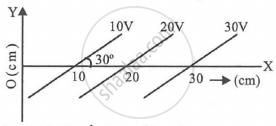
Equipotential surfaces are shown in figure. Then the electric field strength will be ______.
Equipotential surfaces are denser (closer together) in regions where:
The surface of any conductor in electrostatic equilibrium is an equipotential surface because:
In a uniform electric field, the equipotential surfaces take the shape of:
For an electric dipole (+q, −q), the equipotential surfaces are best described as:
A particle floats between two parallel plates separated by 0.1 m with a potential difference of 4000 V. The particle carries a charge of \[1.6 \times 10^{-19}\] C. Taking \[g = 9.8\ \text{m/s}^2\], the mass of the particle is approximately:
