Advertisements
Advertisements
प्रश्न
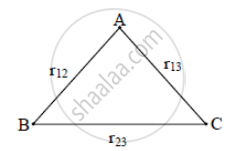
Define electrostatic potential at a point. Write its S.I. unit. Three-point charges q1, q2 and q3 are kept respectively at points A, B, and C as shown in the figure, Derive the expression for the electrostatic potential energy of the system.
Advertisements
उत्तर
The electrostatic potential (V ) at any point in a region with electrostatic field is the work done in bringing a unit positive charge (without acceleration) from infinity to that point. Its S.I. unit is Volt. The potential energy of a system of three charges q1, q2, and q3 located at `vec"r"_1,vec"r"_2,vec"r"_3,`respectively. To bring q1 first from infinity to `vecr_1`, no work is required. Next, we bring q2 from infinity to `vec r_2`,. As before, work done in this step is
`q_2"V"_1(vecr_2,)= (1)/(4piepsilon_0) (q_1q_2)/"r"_12` ...(1)
The charges q1and q2 produce a potential, which at any point P is given by
`"V"_(1,2) = (1)/(4piepsilon_0)(q_1/"r"_(1"P") + q_2/"r"_(2"P"))` .......(2)
Work done next in bringing q3 from infinity to the point `vec"r"_3 "is q3 times V1, 2 at"`
`q_3"V"_(1,2) (vec"r"_3) = (1)/(4piepsilon_0)((q_1q_2)/"r"_12+ (q_2q_3)/"r"_23)` ...(3)
The total work done in assembling the charges at the given locations is obtained by adding the work done in different steps [Eq. (1) and Eq. (3)] and gets stored in the form of potential energy.
`"U" = (1)/(4piepsilon_0) ((q_1q_2)/"r"_12 + (q_1q_3)/"r"_13 + (q_2q_3)/"r"_23)`.
APPEARS IN
संबंधित प्रश्न
If Coulomb’s law involved 1/r3 dependence (instead of 1/r2), would Gauss’s law be still true?
The electrostatic force between the metal plates of an isolated parallel plate capacitor C having a charge Q and area A, is ______.
Which of the following statement is true?
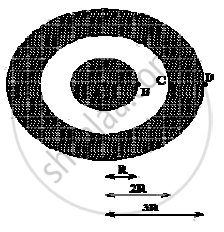
A solid spherical conductor has charge +Q and radius R. It is surrounded by a solid spherical shell with charge -Q, inner radius 2R, and outer radius 3R. Which of the following statements is true?
What is electrostatic shielding?
The statement that the electric field inside a conductor is zero is true under which condition?
What would a tangential component of the electric field at a conductor's surface cause?
For the Gaussian pillbox at a charged conductor's surface, from which face does the flux come?
Why can a comb's attraction for paper be weak or absent on a rainy day or when the hair is wet?
