Advertisements
Advertisements
Question
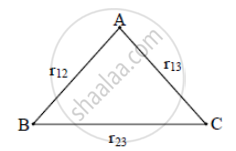
Define electrostatic potential at a point. Write its S.I. unit. Three-point charges q1, q2 and q3 are kept respectively at points A, B, and C as shown in the figure, Derive the expression for the electrostatic potential energy of the system.
Advertisements
Solution
The electrostatic potential (V ) at any point in a region with electrostatic field is the work done in bringing a unit positive charge (without acceleration) from infinity to that point. Its S.I. unit is Volt. The potential energy of a system of three charges q1, q2, and q3 located at `vec"r"_1,vec"r"_2,vec"r"_3,`respectively. To bring q1 first from infinity to `vecr_1`, no work is required. Next, we bring q2 from infinity to `vec r_2`,. As before, work done in this step is
`q_2"V"_1(vecr_2,)= (1)/(4piepsilon_0) (q_1q_2)/"r"_12` ...(1)
The charges q1and q2 produce a potential, which at any point P is given by
`"V"_(1,2) = (1)/(4piepsilon_0)(q_1/"r"_(1"P") + q_2/"r"_(2"P"))` .......(2)
Work done next in bringing q3 from infinity to the point `vec"r"_3 "is q3 times V1, 2 at"`
`q_3"V"_(1,2) (vec"r"_3) = (1)/(4piepsilon_0)((q_1q_2)/"r"_12+ (q_2q_3)/"r"_23)` ...(3)
The total work done in assembling the charges at the given locations is obtained by adding the work done in different steps [Eq. (1) and Eq. (3)] and gets stored in the form of potential energy.
`"U" = (1)/(4piepsilon_0) ((q_1q_2)/"r"_12 + (q_1q_3)/"r"_13 + (q_2q_3)/"r"_23)`.
APPEARS IN
RELATED QUESTIONS
A spherical conductor of radius 12 cm has a charge of 1.6 × 10⁻⁷ C distributed uniformly on its surface. What is the electric field
- inside the sphere
- just outside the sphere
- at a point 18 cm from the centre of the sphere?
A spherical conducting shell of inner radius r1 and outer radius r2 has a charge Q.
(a) A charge q is placed at the centre of the shell. What is the surface charge density on the inner and outer surfaces of the shell?
(b) Is the electric field inside a cavity (with no charge) zero, even if the shell is not spherical, but has any irregular shape? Explain.
A 4 µF capacitor is charged by a 200 V supply. It is then disconnected from the supply and is connected to another uncharged 2 µF capacitors. How much electrostatic energy of the first capacitor is lost in the form of heat and electromagnetic radiation?
If Coulomb’s law involved 1/r3 dependence (instead of 1/r2), would Gauss’s law be still true?
Electric-field magnitude 'E' at points inside and outside a positively charged spherical conductor having charge Q and a radius R are ______.
If R is the radius of a spherical conductor, Vm the dielectric strength, then the maximum electric-field magnitude to which it can be raised is ______.
Consider a finite insulated, uncharged conductor placed near a finite positively charged conductor. The uncharged body must have a potential:
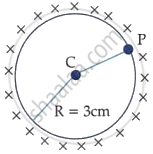
A thin spherical shell is charged by some source. The potential difference between the two points C and P (in V) shown in the figure is:
(Take `1/(4 pi epsilon_0` = 9 × 10⁹ SI units)