Advertisements
Advertisements
Question
If Coulomb’s law involved 1/r3 dependence (instead of 1/r2), would Gauss’s law be still true?
Advertisements
Solution
Gauss’s law will not be true, if Coulomb’s law involved 1/r3 dependence, instead of1/r2, on r.
APPEARS IN
RELATED QUESTIONS
A spherical conductor of radius 12 cm has a charge of 1.6 × 10⁻⁷ C distributed uniformly on its surface. What is the electric field
- inside the sphere
- just outside the sphere
- at a point 18 cm from the centre of the sphere?
(a) Show that the normal component of electrostatic field has a discontinuity from one side of a charged surface to another given by
`(vec"E"_2 - vec"E"_1).hat"n" = sigma/in_0`
Where `hat"n"` is a unit vector normal to the surface at a point and σ is the surface charge density at that point. (The direction of `hat"n"` is from side 1 to side 2.) Hence show that just outside a conductor, the electric field is σ `hat"n"/in_0`
(b) Show that the tangential component of electrostatic field is continuous from one side of a charged surface to another.
[Hint: For (a), use Gauss’s law. For, (b) use the fact that work done by electrostatic field on a closed loop is zero.]
A 12 pF capacitor is connected to a 50 V battery. How much electrostatic energy is stored in the capacitor? If another capacitor of 6 pF is connected in series with it with the same battery connected across the combination, find the charge stored and potential difference across each capacitor.
Electric-field magnitude 'E' at points inside and outside a positively charged spherical conductor having charge Q and a radius R are ______.
If R is the radius of a spherical conductor, Vm the dielectric strength, then the maximum electric-field magnitude to which it can be raised is ______.
Which of the following statements is false for a perfect conductor?
Three Charges 2q, -q and -q lie at vertices of a triangle. The value of E and V at centroid of triangle will be ______.
Consider a finite insulated, uncharged conductor placed near a finite positively charged conductor. The uncharged body must have a potential:
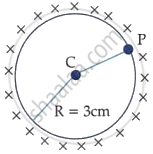
A thin spherical shell is charged by some source. The potential difference between the two points C and P (in V) shown in the figure is:
(Take `1/(4 pi epsilon_0` = 9 × 10⁹ SI units)
What is electrostatic shielding?
Which condition defines electrostatic equilibrium?
Which expression gives the electric field on a charged conductor surface in vector form?
How does an empty cavity inside a conductor relate to electrostatic shielding?
Which justification is used for the formula \[E=\frac{\sigma}{\varepsilon_0}\]?
What did Faraday use to confirm that the room's interior remained charge-free?
What does Gauss's law give for a closed surface when the electric field inside the conductor is zero?
When a dry comb is run through dry hair, what transfers electrons and usually makes the comb negatively charged?
