Advertisements
Advertisements
Question
A 12 pF capacitor is connected to a 50 V battery. How much electrostatic energy is stored in the capacitor? If another capacitor of 6 pF is connected in series with it with the same battery connected across the combination, find the charge stored and potential difference across each capacitor.
Advertisements
Solution
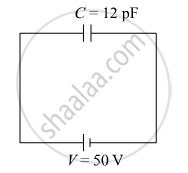
`E=1/2CV^2`
`E=1/2×12×10^-12×(50)^2`
`E=1.5×10^-8 J`
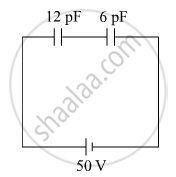
`C_(eqv)=(C_1C_2)/(C_1+C_2)`
`=(12×6)/(12+6)`
`=72/18`
`=4×10^-12 F`
`Q=C_(eqv)V`
`=4×10^-12×50`
`=200×10^-12 C`
Charge stored in both capacitor is `200×10^-12 C`.
Voltage across 12 pF capacitor is `=Q/C= (200×10^-12)/(12×10^-12)=200/12=16.67 V`
Voltage across 12 pF capacitor is`=Q/C= (200×10^-12)/(6×10^-12)=200/6=33.33 V`
APPEARS IN
RELATED QUESTIONS
A spherical conducting shell of inner radius r1 and outer radius r2 has a charge Q.
(a) A charge q is placed at the centre of the shell. What is the surface charge density on the inner and outer surfaces of the shell?
(b) Is the electric field inside a cavity (with no charge) zero, even if the shell is not spherical, but has any irregular shape? Explain.
Which of the following statement is true?
Which of the following statements is false for a perfect conductor?
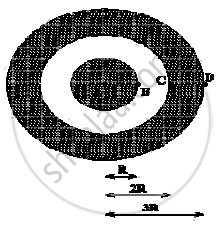
A solid spherical conductor has charge +Q and radius R. It is surrounded by a solid spherical shell with charge -Q, inner radius 2R, and outer radius 3R. Which of the following statements is true?
Where does excess charge reside on a conductor in electrostatic equilibrium?
Which expression gives the electric field on a charged conductor surface in vector form?
What would a tangential component of the electric field at a conductor's surface cause?
Which justification is used for the formula \[E=\frac{\sigma}{\varepsilon_0}\]?
What did Faraday use to line a room in his demonstration?
