Advertisements
Advertisements
प्रश्न
A 12 pF capacitor is connected to a 50 V battery. How much electrostatic energy is stored in the capacitor? If another capacitor of 6 pF is connected in series with it with the same battery connected across the combination, find the charge stored and potential difference across each capacitor.
Advertisements
उत्तर
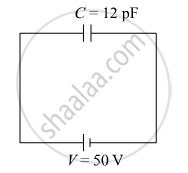
`E=1/2CV^2`
`E=1/2×12×10^-12×(50)^2`
`E=1.5×10^-8 J`
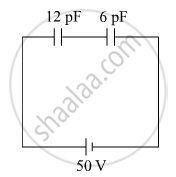
`C_(eqv)=(C_1C_2)/(C_1+C_2)`
`=(12×6)/(12+6)`
`=72/18`
`=4×10^-12 F`
`Q=C_(eqv)V`
`=4×10^-12×50`
`=200×10^-12 C`
Charge stored in both capacitor is `200×10^-12 C`.
Voltage across 12 pF capacitor is `=Q/C= (200×10^-12)/(12×10^-12)=200/12=16.67 V`
Voltage across 12 pF capacitor is`=Q/C= (200×10^-12)/(6×10^-12)=200/6=33.33 V`
APPEARS IN
संबंधित प्रश्न
(a) Show that the normal component of electrostatic field has a discontinuity from one side of a charged surface to another given by
`(vec"E"_2 - vec"E"_1).hat"n" = sigma/in_0`
Where `hat"n"` is a unit vector normal to the surface at a point and σ is the surface charge density at that point. (The direction of `hat"n"` is from side 1 to side 2.) Hence show that just outside a conductor, the electric field is σ `hat"n"/in_0`
(b) Show that the tangential component of electrostatic field is continuous from one side of a charged surface to another.
[Hint: For (a), use Gauss’s law. For, (b) use the fact that work done by electrostatic field on a closed loop is zero.]
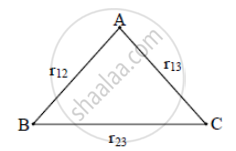
Define electrostatic potential at a point. Write its S.I. unit. Three-point charges q1, q2 and q3 are kept respectively at points A, B, and C as shown in the figure, Derive the expression for the electrostatic potential energy of the system.
Which of the following statements is false for a perfect conductor?
Where does excess charge reside on a conductor in electrostatic equilibrium?
What is an equipotential body?
What does \(\varepsilon_0\) represent in the electric-field formula for a charged conductor surface?
The statement that the electric field inside a conductor is zero is true under which condition?
How does an empty cavity inside a conductor relate to electrostatic shielding?
What does Gauss's law give for a closed surface when the electric field inside the conductor is zero?
Why is a neutral paper piece attracted to a charged comb?
