Advertisements
Advertisements
प्रश्न
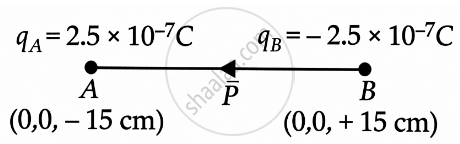
A system has two charges qA = 2.5 × 10⁻⁷ C and qB = −2.5 × 10⁻⁷ C located at points A: (0, 0, −15 cm) and B: (0, 0, +15 cm), respectively. What are the total charge and electric dipole moment of the system?
Advertisements
उत्तर
qnet = qA + qB
qnet = 2.5 × 10⁻⁷ + (−2.5 × 10⁻⁷)
= 2.5 × 10⁻⁷ − 2.5 × 10−7
= 0
Distance between two charges at points A and B,
d = 15 + 15
= 30 cm
= 0.3 m
The electric dipole moment of the system is given by,
= 2.5 × 10−7 × 0.3
= 7.5 × 10⁻⁸ C m directed along BA
संबंधित प्रश्न
Depict the orientation of the dipole in (i) stable, (ii) unstable equilibrium in a uniform electric field.
In which orientation, a dipole placed in a uniform electric field is in (i) stable, (ii) unstable equilibrium?
Two particles, carrying charges −q and +q and and of mass m each, are fixed at the ends of a light rod of length a to form a dipole. The rod is clamped at an end and is placed in a uniform electric field E with the axis of the dipole along the electric field. The rod is slightly tilted and then released. Neglecting gravity, find the time period of small oscillations.
An electric dipole consists of two opposite charges each 0.05 µC separated by 30 mm. The dipole is placed in an unifom1 external electric field of 106 NC-1. The maximum torque exerted by the field on the dipole is ______
When an electric dipole p is placed in a uniform electric field E then at what angle the value of torque will be maximum?
A short electric dipole bas a dipole moment of 16 x 10-9 C m. The electric potential due to the dipole at a point at a distance of 0.6 m from the centre of the dipole, situated on a line making an angle of 60° with the dipole axis is: ____________. `(1/(4piepsilon_0) = 9 xx 10^9 "Nm"^2// "C"^2)`
Electric charges q, q, - 2q are placed at the comers of an equilateral triangle ABC of side l. The magnitude of electric dipole moment of the system is ____________.
A dipole is placed in an electric field as shown. In which direction will it move?

What work must be done to rotate an electric dipole through an angle θ with the electric field, if an electric dipole of moment p is placed in a uniform electric field E with p parallel to E?
Show that intensity of electric field at a point in broadside position of an electric dipole is given by:
E = `(1/(4 pi epsilon_0)) p/((r^2 + l^2)^(3//2))`
Where the terms have their usual meaning.
The electric dipole moment \[\vec{p}\] is defined mathematically as:
The SI unit of electric dipole moment is:
At a point P on the equatorial line of a dipole, both charges are at equal distances. This distance is expressed as:
For a short dipole at a point P on the equatorial line, where r ≫ a, the electric field is given by:
The electric potential at a point P due to a dipole (at distance r from the centre, at angle θ from the dipole axis) is given by:
Carbon dioxide (CO₂) has zero net dipole moment even though it contains polar C=O bonds. Why?
For the configuration with +0.25 μC at (0, 0, −15 cm) and −0.25 μC at (0, 0, +15 cm), the direction of the dipole moment is:
