Advertisements
Advertisements
प्रश्न
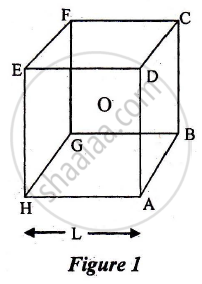
A short electric dipole (which consists of two point charges, +q and -q) is placed at the centre 0 and inside a large cube (ABCDEFGH) of length L, as shown in Figure 1. The electric flux, emanating through the cube is:
a) `q"/"4piin_9L`
b) zero
c) `q"/"2piin_0L`
d) `q"/"3piin_0L`
Advertisements
उत्तर
Zero
APPEARS IN
संबंधित प्रश्न
Write the expression for the torque \[\vec{\tau}\] acting on a dipole of dipole moment \[\vec{p}\] placed in an electric field \[\vec{E}\].
Answer the following question.
Derive an expression for the electric field at any point on the equatorial line of an electric dipole.
Dimensions of mass in electric field and in electric dipole moment are respectively.
An electric dipole of moment p is placed parallel to the uniform electric field. The amount of work done in rotating the dipole by 90° is ____________.
A dipole is placed in an electric field as shown. In which direction will it move?

The dimensional formula for electric dipole moment is:
When a dipole is aligned with the external electric field (θ = 0°), the potential energy is:
The electric potential at a point P due to a dipole (at distance r from the centre, at angle θ from the dipole axis) is given by:
A configuration consists of charges +q, −2q, and +q at the vertices of an equilateral triangle with side length 2l. Treating this as a combination of two dipoles, what is the net dipole moment?
