Advertisements
Advertisements
प्रश्न
What is relative permittivity?
Advertisements
उत्तर
- Relative permittivity or dielectric constant is the ratio of the absolute permittivity of a medium to the permittivity of free space. It is denoted as K or εr.
i.e., K or εr = `ε/(ε_0)` - It is the ratio of the force between two point charges placed a certain distance apart in free space or vacuum to the force between the same two-point charges when placed at the same distance in the given medium.
i.e., K or εr = `"F"_"vacuum"/"F"_"medium"` - It is also called a specific inductive capacity or dielectric constant.
APPEARS IN
संबंधित प्रश्न
Check that the ratio `(ke^2)/(G m_em_p)` is dimensionless. Look up a Table of Physical Constants and determine the value of this ratio. What does the ratio signify?
Four point charges qA = 2 μC, qB = −5 μC, qC = 2 μC, and qD = −5 μC are located at the corners of a square ABCD of side 10 cm. What is the force on a charge of 1 μC placed at the centre of the square?
Three-point charges q, – 4q and 2q are placed at the vertices of an equilateral triangle ABC of side 'l' as shown in the figure. Obtain the expression for the magnitude of the resultant electric force acting on the charge q
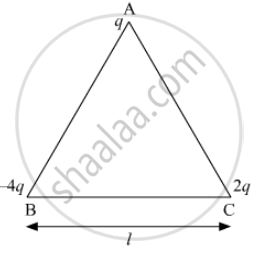
(b) Find out the amount of the work done to separate the charges at infinite distance.
Write any two important points of similarities and differences each between Coulomb's law for the electrostatic field and Biot-Savart's law of the magnetic field ?
Two equal charges are placed at a separation of 1.0 m. What should be the magnitude of the charges, so that the force between them equals the weight of a 50 kg person?
Consider a gold nucleus to be a sphere of radius 6.9 fermi in which protons and neutrons are distributed. Find the force of repulsion between two protons situated at largest separation. Why do these protons not fly apart under this repulsion?
NaCl molecule is bound due to the electric force between the sodium and the chlorine ions when one electron of sodium is transferred to chlorine. Taking the separation between the ions to be 2.75 × 10⁻⁸ cm, find the force of attraction between them. State the assumptions (if any) that you have made.
Four equal charges of 2.0 × 10⁻⁶ C each are fixed at the four corners of a square of side 5 cm. Find the Coulomb's force experienced by one of the charges due to the other three.
Two charged particles with charge 2.0 × 10⁻⁸ C each are joined by an insulating string of length 1 m and the system is kept on a smooth horizontal table. Find the tension in the string.
A particle A with a charge of 2.0 × 10⁻⁶ C is held fixed on a horizontal table. A second charged particle of mass 80 g stays in equilibrium on the table at a distance of 10 cm from the first charge. The coefficient of friction between the table and this second particle is μ = 0.2. Find the range within which the charge of this second particle may lie.
Write a short note on superposition principle.
Two-point charges of + 0.2 µµC and -0.2 µµC are separated by 1 o8 m. What is the value of the electric field at an axial point at a distance of 0.1 m from their mid-point?
A force F acts between sodium and chlorine ions of salt (sodium chloride) when put 1 cm apart in air. The permittivity of air and dielectric constant of water are `epsilon_0` and K respectively. When a piece of salt is put in water, electrical force acting between sodium and chlorine ions 1 cm apart is ____________.
The electric force acting between two point charges kept at a certain distance in vacuum is 16 N. If the same two charges are kept at the same distance in a medium of dielectric constant 8, the electric force acting between them is ____________ N.
A total charge Q is broken in two parts Q1 and Q2 and they are placed at a distance R from each other. The maximum force of repulsion between them will occur, when ____________.
The ratio of the forces between two small spheres with constant charge (a) in air (b) in a medium of dielectric constant K is ______.
Two positive charges ______.
Two charge – 10c and + 10 c are placed 10 cm apart. Potential at centre of the line joining the two charge is:-
The S.I unit of electric permittivity is
Identify the wrong statement in the following.
Coulomb's law correctly describes the electric force that ______.
Electric charge of any system is ______.
There is another useful system of units, besides the SI/mks A system, called the cgs (centimeter-gram-second) system. In this system Coloumb’s law is given by
F = `(Qq)/r^2 hatr`
where the distance r is measured in cm (= 10–2 m), F in dynes (= 10–5 N) and the charges in electrostatic units (es units), where 1 es unit of charge = `1/([3]) xx 10^-9 C`
The number [3] actually arises from the speed of light in vaccum which is now taken to be exactly given by c = 2.99792458 × 10⁸ m/s. An approximate value of c then is c = [3] × 108 m/s.
(i) Show that the coloumb law in cgs units yields
1 esu of charge = 1 (dyne)1/2 cm.
Obtain the dimensions of units of charge in terms of mass M, length L and time T. Show that it is given in terms of fractional powers of M and L.
(ii) Write 1 esu of charge = x C, where x is a dimensionless number. Show that this gives
`1/(4pi ∈_0) = 10^-9/x^2 (N*m^2)/C^2`
With `x = 1/([3]) xx 10^-9`, we have `1/(4pi ∈_0) = [3]^2 xx 10^9 (Nm^2)/C^2`
or, `1/(4pi ∈_0) = (2.99792458)^2 xx 10^9 (Nm^2)/C^2` (exactly).
According to Coulomb's law, which is the correct relation for the following figure?

Which of the following statements about nuclear forces is not true?
Two point charges Q each are placed at a distance d apart. A third point charge q is placed at a distance x from the mid-point on the perpendicular bisector. The value of x at which charge q will experience the maximum Coulomb's force is ______.
The ratio of the forces between two charges placed at a certain distance apart in the air and by the same distance apart in a medium of dielectric constant K is ______.
