Advertisements
Advertisements
प्रश्न
Three identical charges, each with a value of 1.0 × 10⁻⁸ C, are placed at the corners of an equilateral triangle of side 20 cm. Find the electric field and potential at the centre of the triangle.
Advertisements
उत्तर
Given:
Magnitude of charges, q = 1.0 × 10⁻⁸ C
Side of the triangle,
l = 20 cm = 0.2 m
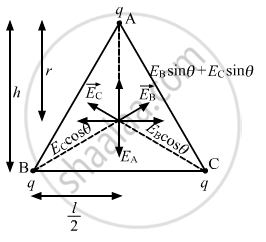
Let \[E_A , E_B \text{ and } E_C\] be the electric fields at the centre due to the charges at A, B and C, respectively.
The distance of the centre is the same from all the charges. So,
\[E_{net} = E_A - \left( E_B \sin\theta + E_A \sin\theta \right)\]
\[ = E\left( 1 - \sin30^\circ- \sin30^\circ \right)\]
\[ \Rightarrow E_{net} = 0\]
Now,
\[h^2 = l^2 - \left( \frac{l}{2} \right)^2 \]
\[ h^2 = \left( 0 . 2 \right)^2 - \left( 0 . 1 \right)^2 \]
\[ \Rightarrow h = \frac{\sqrt{3}}{10}\]
Let the distance of the centre from each charge be r.
For an equilateral triangle,
\[r = \frac{2}{3}h\]
\[ \Rightarrow r = \frac{2}{3} \times \frac{1 . 732}{10} = 1 . 15 \times {10}^{- 1} \] m
Potential at the centre,
\[V = V_A + V_B + V_C \]
\[ \because V_A = V_B = V_{C,} \]
\[ V = 3 V_A\]
\[V = 3 \times \frac{1}{4\pi \epsilon_0}\frac{q}{r}\]
\[V = \frac{3 \times 9 \times {10}^9 \times {10}^{- 8}}{0 . 115}\]
APPEARS IN
संबंधित प्रश्न
Four point charges qA = 2 μC, qB = −5 μC, qC = 2 μC, and qD = −5 μC are located at the corners of a square ABCD of side 10 cm. What is the force on a charge of 1 μC placed at the centre of the square?
A particle of mass m and charge (−q) enters the region between the two charged plates initially moving along x-axis with speed vx (like particle 1 in the fig.). The length of plate is L and an uniform electric field E is maintained between the plates. Show that the vertical deflection of the particle at the far edge of the plate is qEL2/(2m`"v"_"x"^2`).

Find the dimensional formula of ε0.
Two equal charges are placed at a separation of 1.0 m. What should be the magnitude of the charges, so that the force between them equals the weight of a 50 kg person?
Two charges 2.0 × 10⁻⁶ C and 1.0 × 10⁻⁶ C are placed at a separation of 10 cm. Where should a third charge be placed, such that it experiences no net force due to these charges?
Two identical pith balls, each carrying a charge q, are suspended from a common point by two strings of equal length l. Find the mass of each ball if the angle between the strings is 2θ in equilibrium.
A particle with a charge of 2.0 × 10⁻⁴ C is placed directly below and at a separation of 10 cm from the bob of a simple pendulum at rest. The mass of the bob is 100 g. What charge should the bob be given so that the string becomes loose?
A particle A with a charge of 2.0 × 10⁻⁶ C and a mass of 100 g is placed at the bottom of a smooth inclined plane of inclination 30°. Where should another particle B, with the same charge and mass, be placed on the incline so that it may remain in equilibrium?
Two particles A and B, each carrying a charge Q, are held fixed with a separation dbetween them. A particle C of mass m and charge q is kept at the middle point of the line AB. Assuming x<<d, show that this force is proportional to x.
A water particle of mass 10.0 mg and with a charge of 1.50 × 10⁻⁶ C stays suspended in a room. What is the magnitude of electric field in the room? What is its direction ?
Two identical particles, each with a charge of 2.0 × 10⁻⁴ C and mass of 10 g, are kept at a separation of 10 cm and then released. What would be the speed of the particles when the separation becomes large?
Two particles of masses 5.0 g each and opposite charges of +4.0 × 10⁻⁵ C and −4.0 × 10⁻⁵ C are released from rest with a separation of 1.0 m between them. Find the speeds of the particles when the separation is reduced to 50 cm.
Write down Coulomb’s law in vector form and mention what each term represents.
Explain in detail Coulomb’s law and its various aspects.
The electric force acting between two point charges kept at a certain distance in vacuum is 16 N. If the same two charges are kept at the same distance in a medium of dielectric constant 8, the electric force acting between them is ____________ N.
Two positive charges ______.
The unit of charge is ______.
Two identical thin rings, each of radius a meter, are coaxially placed at a distance R meter apart. If Q1 coulomb and Q2 coulomb are respectively the charges uniformly spread on the two rings, the work done in moving a charge q coulomb from the centre of one ring to that of the other is ______.
Two point charges Q each are placed at a distance d apart. A third point charge q is placed at a distance x from the mid-point on the perpendicular bisector. The value of x at which charge q will experience the maximum Coulomb's force is ______.
