Advertisements
Advertisements
प्रश्न
Three identical charges, each with a value of 1.0 × 10⁻⁸ C, are placed at the corners of an equilateral triangle of side 20 cm. Find the electric field and potential at the centre of the triangle.
Advertisements
उत्तर
Given:
Magnitude of charges, q = 1.0 × 10⁻⁸ C
Side of the triangle,
l = 20 cm = 0.2 m
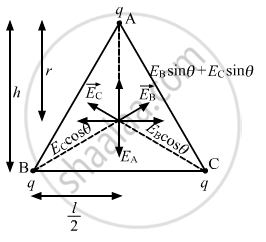
Let \[E_A , E_B \text{ and } E_C\] be the electric fields at the centre due to the charges at A, B and C, respectively.
The distance of the centre is the same from all the charges. So,
\[E_{net} = E_A - \left( E_B \sin\theta + E_A \sin\theta \right)\]
\[ = E\left( 1 - \sin30^\circ- \sin30^\circ \right)\]
\[ \Rightarrow E_{net} = 0\]
Now,
\[h^2 = l^2 - \left( \frac{l}{2} \right)^2 \]
\[ h^2 = \left( 0 . 2 \right)^2 - \left( 0 . 1 \right)^2 \]
\[ \Rightarrow h = \frac{\sqrt{3}}{10}\]
Let the distance of the centre from each charge be r.
For an equilateral triangle,
\[r = \frac{2}{3}h\]
\[ \Rightarrow r = \frac{2}{3} \times \frac{1 . 732}{10} = 1 . 15 \times {10}^{- 1} \] m
Potential at the centre,
\[V = V_A + V_B + V_C \]
\[ \because V_A = V_B = V_{C,} \]
\[ V = 3 V_A\]
\[V = 3 \times \frac{1}{4\pi \epsilon_0}\frac{q}{r}\]
\[V = \frac{3 \times 9 \times {10}^9 \times {10}^{- 8}}{0 . 115}\]
APPEARS IN
संबंधित प्रश्न
The electrostatic force on a small sphere of charge 0.4 μC due to another small sphere of charge − 0.8 μC in air is 0.2 N.
- What is the distance between the two spheres?
- What is the force on the second sphere due to the first?
Check that the ratio ke2/G memp is dimensionless. Look up a Table of Physical Constants and determine the value of this ratio. What does the ratio signify?
A particle of mass m and charge (−q) enters the region between the two charged plates initially moving along x-axis with speed vx (like particle 1 in the fig.). The length of plate is L and an uniform electric field E is maintained between the plates. Show that the vertical deflection of the particle at the far edge of the plate is qEL2/(2m`"v"_"x"^2`).

Plot a graph showing the variation of coulomb force (F) versus ,`(1/r^2)` where r is the distance between the two charges of each pair of charges: (1 μC, 2 μC) and (2 μC, − 3 μC). Interpret the graphs obtained.
Find the dimensional formula of ε0.
A hydrogen atom contains one proton and one electron. It may be assumed that the electron revolves in a circle of radius 0.53 angstrom (1 angstrom = 10−10 m and is abbreviated as Å ) with the proton at the centre. The hydrogen atom is said to be in the ground state in this case. Find the magnitude of the electric force between the proton and the electron of a hydrogen atom in its ground state.
A particle with a charge of 2.0 × 10⁻⁴ C is placed directly below and at a separation of 10 cm from the bob of a simple pendulum at rest. The mass of the bob is 100 g. What charge should the bob be given so that the string becomes loose?
Two identically-charged particles are fastened to the two ends of a spring of spring constant 100 N m−1 and natural length 10 cm. The system rests on a smooth horizontal table. If the charge on each particle is 2.0 × 10⁻⁸ C, find the extension in the length of the spring. Assume that the extension is small as compared to the natural length. Justify this assumption after you solve the problem.
Two particles A and B, each carrying a charge Q, are held fixed with a separation dbetween them. A particle C of mass m and charge q is kept at the middle point of the line AB. Assuming x<<d, show that this force is proportional to x.
Two particles A and B, each carrying a charge Q, are held fixed with a separation dbetween them. A particle C of mass m and charge q is kept at the middle point of the line AB. Under what conditions will the particle C execute simple harmonic motion if it is released after such a small displacement? Find the time period of the oscillations if these conditions are satisfied.
Repeat the previous problem if the particle C is displaced through a distance x along the line AB.
Write down Coulomb’s law in vector form and mention what each term represents.
Two identical thin rings, each of radius a meter, are coaxially placed at a distance R meter apart. If Q1 coulomb and Q2 coulomb are respectively the charges uniformly spread on the two rings, the work done in moving a charge q coulomb from the centre of one ring to that of the other is ______.
A charge Q is divided into two parts of q and Q – q. If the coulomb repulsion between them when they are separated is to be maximum, the ratio of Q/q should be ______.
Four equal charges q are placed at the four comers A, B, C, D of a square of length a. The magnitude of the force on the charge at B will be ______.

Coulomb's law is given by F = k q1q2 rn where n is
The S.I unit of electric permittivity is
There is another useful system of units, besides the SI/mks A system, called the cgs (centimeter-gram-second) system. In this system Coloumb’s law is given by
F = `(Qq)/r^2 hatr`
where the distance r is measured in cm (= 10–2 m), F in dynes (= 10–5 N) and the charges in electrostatic units (es units), where 1 es unit of charge = `1/([3]) xx 10^-9 C`
The number [3] actually arises from the speed of light in vaccum which is now taken to be exactly given by c = 2.99792458 × 10⁸ m/s. An approximate value of c then is c = [3] × 108 m/s.
(i) Show that the coloumb law in cgs units yields
1 esu of charge = 1 (dyne)1/2 cm.
Obtain the dimensions of units of charge in terms of mass M, length L and time T. Show that it is given in terms of fractional powers of M and L.
(ii) Write 1 esu of charge = x C, where x is a dimensionless number. Show that this gives
`1/(4pi ∈_0) = 10^-9/x^2 (N*m^2)/C^2`
With `x = 1/([3]) xx 10^-9`, we have `1/(4pi ∈_0) = [3]^2 xx 10^9 (Nm^2)/C^2`
or, `1/(4pi ∈_0) = (2.99792458)^2 xx 10^9 (Nm^2)/C^2` (exactly).
Which of the following statements about nuclear forces is not true?
