Advertisements
Advertisements
प्रश्न
A positive charge Q is distributed uniformly over a circular ring of radius R. A particle of mass m, and a negative charge q, is placed on its axis at a distance x from the centre. Find the force on the particle. Assuming x << R, find the time period of oscillation of the particle if it is released from there .
Advertisements
उत्तर
Consider an element of angular width \[d\theta\] at a distance r from the charge q on the circular ring, as shown in the figure.
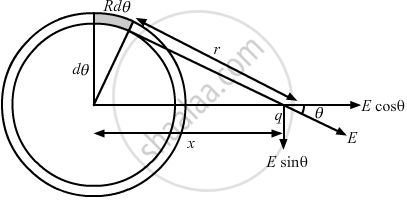
\[dE = \frac{dq}{4\pi \epsilon_0}\frac{1}{r^2}\]
\[ = \frac{\frac{Q}{2\pi}d\theta}{4\pi \epsilon_0}\frac{1}{R^2 + x^2}\]
By the symmetry, the E sinθ component of all such elements on the ring will vanish.
So, net electric field,
\[d E_{net} = dE\cos\theta = \frac{Qd\theta}{8 \pi^2 \epsilon_0 \left( R^2 + x^2 \right)^{3/2}}\]
Total force on the charged particle,
\[F = \int qd E_{net} \]
\[ = \frac{qQ}{8 \pi^2 \epsilon_0}\frac{x}{\left( R^2 + x^2 \right)^{3/2}} \int_0^{2\pi} d\theta\]
\[ = \frac{xQq}{4\pi \epsilon_0 \left( R^2 + x^2 \right)^{3/2}}\]
According to the question,
\[x < < R\]
\[F = \frac{Qq x}{4\pi \epsilon_0 R^3}\]
Comparing this with the condition of simple harmonic motion, we get
\[F = m \omega^2 x\]
\[ \Rightarrow m \omega^2 = \frac{Qq}{4\pi \epsilon_0 R^3}\]
\[ \Rightarrow m \left( \frac{2\pi}{T} \right)^2 = \frac{Qq}{4\pi \epsilon_0 R^3}\]
\[ \Rightarrow T = \left[ \frac{16 \pi^3 \epsilon_0 m R^3}{Qq} \right]^{1/2}\]
