Advertisements
Advertisements
Question
Three identical charges, each with a value of 1.0 × 10⁻⁸ C, are placed at the corners of an equilateral triangle of side 20 cm. Find the electric field and potential at the centre of the triangle.
Advertisements
Solution
Given:
Magnitude of charges, q = 1.0 × 10⁻⁸ C
Side of the triangle,
l = 20 cm = 0.2 m
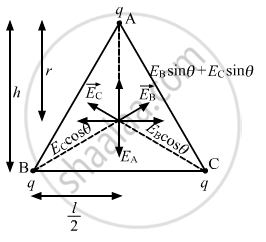
Let \[E_A , E_B \text{ and } E_C\] be the electric fields at the centre due to the charges at A, B and C, respectively.
The distance of the centre is the same from all the charges. So,
\[E_{net} = E_A - \left( E_B \sin\theta + E_A \sin\theta \right)\]
\[ = E\left( 1 - \sin30^\circ- \sin30^\circ \right)\]
\[ \Rightarrow E_{net} = 0\]
Now,
\[h^2 = l^2 - \left( \frac{l}{2} \right)^2 \]
\[ h^2 = \left( 0 . 2 \right)^2 - \left( 0 . 1 \right)^2 \]
\[ \Rightarrow h = \frac{\sqrt{3}}{10}\]
Let the distance of the centre from each charge be r.
For an equilateral triangle,
\[r = \frac{2}{3}h\]
\[ \Rightarrow r = \frac{2}{3} \times \frac{1 . 732}{10} = 1 . 15 \times {10}^{- 1} \] m
Potential at the centre,
\[V = V_A + V_B + V_C \]
\[ \because V_A = V_B = V_{C,} \]
\[ V = 3 V_A\]
\[V = 3 \times \frac{1}{4\pi \epsilon_0}\frac{q}{r}\]
\[V = \frac{3 \times 9 \times {10}^9 \times {10}^{- 8}}{0 . 115}\]
