Advertisements
Advertisements
Question
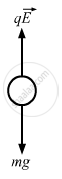
A water particle of mass 10.0 mg and with a charge of 1.50 × 10⁻⁶ C stays suspended in a room. What is the magnitude of electric field in the room? What is its direction ?
Advertisements
Solution
Mass of the particle,
\[m = 10 \text{mg } = 10 \times {10}^{- 5} \] kg
Charge on the particle,
\[q = 1 . 5 \times {10}^{- 6} C\]
Let the magnitude of the electric field be E.
The particle stays suspended. Therefore,
Downward gravitational force = Upward electric force
That is, mg = qE
\[\Rightarrow E = \frac{mg}{q} = \frac{10 \times {10}^{- 5} \times 10}{1 . 5 \times {10}^{- 6}}\]
\[ = \frac{1000}{15} = 66 . 7 \] N/C
The direction of the electric field will be upward to balance the downward gravitational force.
APPEARS IN
RELATED QUESTIONS
Check that the ratio ke2/G memp is dimensionless. Look up a Table of Physical Constants and determine the value of this ratio. What does the ratio signify?
Find the dimensional formula of ε0.
Consider a gold nucleus to be a sphere of radius 6.9 fermi in which protons and neutrons are distributed. Find the force of repulsion between two protons situated at largest separation. Why do these protons not fly apart under this repulsion?
Find the ratio of the electrical and gravitational forces between two protons.
Suppose an attractive nuclear force acts between two protons which may be written as F=Ce−kr/r2. Write down the dimensional formulae and appropriate SI units of C and k.
Suppose an attractive nuclear force acts between two protons which may be written as F=Ce−kr/r2. Suppose that k = 1 fermi−1 and that the repulsive electric force between the protons is just balanced by the attractive nuclear force when the separation is 5 fermi. Find the value of C.
Find the speed of the electron in the ground state of a hydrogen atom. The description of ground state is given in the previous problem.
Ten positively-charged particles are kept fixed on the x-axis at points x = 10 cm, 20 cm, 30 cm, ...., 100 cm. the first particle has a charge 1.0 × 10⁻⁸ C, the second 8 × 10⁻⁸ C, the third 27 × 10−8 C and so on. The tenth particle has a charge 1000 × 10−8 C. Find the magnitude of the electric force acting on a 1 C charge placed at the origin.
Two small spheres, each with a mass of 20 g, are suspended from a common point by two insulating strings of length 40 cm each. The spheres are identically charged and the separation between the balls at equilibrium is found to be 4 cm. Find the charge on each sphere.
Two identical particles, each with a charge of 2.0 × 10⁻⁴ C and mass of 10 g, are kept at a separation of 10 cm and then released. What would be the speed of the particles when the separation becomes large?
Two particles of masses 5.0 g each and opposite charges of +4.0 × 10⁻⁵ C and −4.0 × 10⁻⁵ C are released from rest with a separation of 1.0 m between them. Find the speeds of the particles when the separation is reduced to 50 cm.
Define a unit charge.
What is relative permittivity?
Write down Coulomb’s law in vector form and mention what each term represents.
A force F acts between sodium and chlorine ions of salt (sodium chloride) when put 1 cm apart in air. The permittivity of air and dielectric constant of water are `epsilon_0` and K respectively. When a piece of salt is put in water, electrical force acting between sodium and chlorine ions 1 cm apart is ____________.
The unit of charge is ______.
SI unit of permittivity of free space is ______.
Four equal charges q are placed at the four comers A, B, C, D of a square of length a. The magnitude of the force on the charge at B will be ______.

According to Coulomb's law, which is the correct relation for the following figure?

Four charges equal to −Q are placed at the four a corners of a square and charge q is at its centre. If the system is in equilibrium, the value of q is ______.