Advertisements
Advertisements
प्रश्न
Two identical pith balls, each carrying a charge q, are suspended from a common point by two strings of equal length l. Find the mass of each ball if the angle between the strings is 2θ in equilibrium.
Advertisements
उत्तर
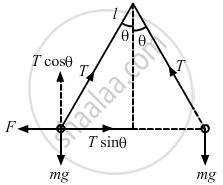
Let the tension in the string be T and force of attraction between the two balls be F.
From the free-body diagram of the ball, we get
Tcos θ = mg ...(1)
Tsin θ = F ...(2)
\[\Rightarrow \tan\theta = \frac{F}{mg}\]
\[ \Rightarrow m = \frac{F}{g\tan\theta} \ldots\left( 3 \right)\]
Here, separation between the two charges,
\[r = 2l\sin\theta\]
\[F = \frac{1}{4\pi \epsilon_0}\frac{q^2}{r^2} = \frac{1}{4\pi \epsilon_0} \times \frac{q^2}{\left( 2l\sin\theta \right)^2}\]
Substituting the value of F in equation (3), we get
\[m = \frac{q^2 \cot\theta}{16\pi \epsilon_0 g l^2 \sin^2 \theta}\]
APPEARS IN
संबंधित प्रश्न
A particle of mass m and charge (−q) enters the region between the two charged plates initially moving along x-axis with speed vx (like particle 1 in the fig.). The length of plate is L and an uniform electric field E is maintained between the plates. Show that the vertical deflection of the particle at the far edge of the plate is qEL2/(2m`"v"_"x"^2`).

A charge of 1.0 C is placed at the top of your college building and another equal charge at the top of your house. Take the separation between the two charges to be 2.0 km. Find the force exerted by the charges on each other. How many times your weight is this force?
Two equal charges are placed at a separation of 1.0 m. What should be the magnitude of the charges, so that the force between them equals the weight of a 50 kg person?
Suppose the second charge in the previous problem is −1.0 × 10⁻⁶ C. Locate the position where a third charge will not experience a net force.
Consider a gold nucleus to be a sphere of radius 6.9 fermi in which protons and neutrons are distributed. Find the force of repulsion between two protons situated at largest separation. Why do these protons not fly apart under this repulsion?
Two identical balls, each with a charge of 2.00 × 10⁻⁷ C and a mass of 100 g, are suspended from a common point by two insulating strings, each 50 cm long. The balls are held at a separation 5.0 cm apart and then released. Find.
(a) the electric force on one of the charged balls
(b) the components of the resultant force on it along and perpendicular to the string
(c) the tension in the string
(d) the acceleration of one of the balls. Answers are to be obtained only for the instant just after the release.
Repeat the previous problem if the particle C is displaced through a distance x along the line AB.
Define a unit charge.
Polarised dielectric is equivalent to ______.
The ratio of the forces between two small spheres with constant charge (a) in air (b) in a medium of dielectric constant K is ______.
Two positive charges ______.
The unit of charge is ______.
Two charge – 10c and + 10 c are placed 10 cm apart. Potential at centre of the line joining the two charge is:-
Electric charge of any system is ______.
The ratio of the forces between two charges placed at a certain distance apart in the air and by the same distance apart in a medium of dielectric constant K is ______.
Four charges equal to −Q are placed at the four a corners of a square and charge q is at its centre. If the system is in equilibrium, the value of q is ______.
