Advertisements
Advertisements
प्रश्न
Two small spheres, each with a mass of 20 g, are suspended from a common point by two insulating strings of length 40 cm each. The spheres are identically charged and the separation between the balls at equilibrium is found to be 4 cm. Find the charge on each sphere.
Advertisements
उत्तर
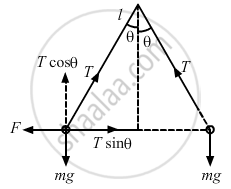
Tcosθ = mg ...(i)
Tsinθ = Fe ...(ii)
Here,
\[F_e = \frac{1}{4 \pi\epsilon_0}\frac{q^2}{r^2}\]
\[\tan\theta = \frac{2}{39 . 9}\]
Dividing equation (ii) by (i), we get
\[\tan\theta = \frac{F_e}{\text{ mg }}\]
\[ \Rightarrow \tan\theta = \frac{1}{4 \pi\epsilon_0}\frac{q^2}{r^2} . \frac{1}{\text{mg}}\]
\[ \Rightarrow q^2 = \frac{\tan\theta . r^2 . \text{mg}}{1/4 \pi\epsilon_0}\]
\[ \Rightarrow q^2 = 17 \times {10}^{- 16} \]
\[ \Rightarrow q = 4 . 123 \times {10}^{- 8} C\]
APPEARS IN
संबंधित प्रश्न
Two equal balls with equal positive charge 'q' coulombs are suspended by two insulating strings of equal length. What would be the effect on the force when a plastic sheet is inserted between the two?
The electrostatic force on a small sphere of charge 0.4 μC due to another small sphere of charge − 0.8 μC in air is 0.2 N.
- What is the distance between the two spheres?
- What is the force on the second sphere due to the first?
One end of a 10 cm long silk thread is fixed to a large vertical surface of a charged non-conducting plate and the other end is fastened to a small ball of mass 10 g and a charge of 4.0× 10⁻⁶ C. In equilibrium, the thread makes an angle of 60° with the vertical. Find the surface charge density on the plate.
Two charged particles are placed 1.0 cm apart. What is the minimum possible magnitude of the electric force acting on each charge?
Two insulating small spheres are rubbed against each other and placed 1 cm apart. If they attract each other with a force of 0.1 N, how many electrons were transferred from one sphere to the other during rubbing?
A hydrogen atom contains one proton and one electron. It may be assumed that the electron revolves in a circle of radius 0.53 angstrom (1 angstrom = 10−10 m and is abbreviated as Å ) with the proton at the centre. The hydrogen atom is said to be in the ground state in this case. Find the magnitude of the electric force between the proton and the electron of a hydrogen atom in its ground state.
Ten positively-charged particles are kept fixed on the x-axis at points x = 10 cm, 20 cm, 30 cm, ...., 100 cm. the first particle has a charge 1.0 × 10⁻⁸ C, the second 8 × 10⁻⁸ C, the third 27 × 10−8 C and so on. The tenth particle has a charge 1000 × 10−8 C. Find the magnitude of the electric force acting on a 1 C charge placed at the origin.
Two charged particles with charge 2.0 × 10⁻⁸ C each are joined by an insulating string of length 1 m and the system is kept on a smooth horizontal table. Find the tension in the string.
Two identical balls, each with a charge of 2.00 × 10⁻⁷ C and a mass of 100 g, are suspended from a common point by two insulating strings, each 50 cm long. The balls are held at a separation 5.0 cm apart and then released. Find.
(a) the electric force on one of the charged balls
(b) the components of the resultant force on it along and perpendicular to the string
(c) the tension in the string
(d) the acceleration of one of the balls. Answers are to be obtained only for the instant just after the release.
Two identical pith balls, each carrying a charge q, are suspended from a common point by two strings of equal length l. Find the mass of each ball if the angle between the strings is 2θ in equilibrium.
Two identically-charged particles are fastened to the two ends of a spring of spring constant 100 N m−1 and natural length 10 cm. The system rests on a smooth horizontal table. If the charge on each particle is 2.0 × 10⁻⁸ C, find the extension in the length of the spring. Assume that the extension is small as compared to the natural length. Justify this assumption after you solve the problem.
A force F acts between sodium and chlorine ions of salt (sodium chloride) when put 1 cm apart in air. The permittivity of air and dielectric constant of water are `epsilon_0` and K respectively. When a piece of salt is put in water, electrical force acting between sodium and chlorine ions 1 cm apart is ____________.
The electric force acting between two point charges kept at a certain distance in vacuum is 16 N. If the same two charges are kept at the same distance in a medium of dielectric constant 8, the electric force acting between them is ____________ N.
Two point charges +3 µC and +8 µC repel each other with a force of 40 N. If a charge of -5 µC is added to each of them, then force between them will become ______.
Two identical thin rings, each of radius a meter, are coaxially placed at a distance R meter apart. If Q1 coulomb and Q2 coulomb are respectively the charges uniformly spread on the two rings, the work done in moving a charge q coulomb from the centre of one ring to that of the other is ______.
The S.I unit of electric permittivity is
