Advertisements
Advertisements
Question
What is relative permittivity?
Advertisements
Solution
- Relative permittivity or dielectric constant is the ratio of the absolute permittivity of a medium to the permittivity of free space. It is denoted as K or εr.
i.e., K or εr = `ε/(ε_0)` - It is the ratio of the force between two point charges placed a certain distance apart in free space or vacuum to the force between the same two-point charges when placed at the same distance in the given medium.
i.e., K or εr = `"F"_"vacuum"/"F"_"medium"` - It is also called a specific inductive capacity or dielectric constant.
APPEARS IN
RELATED QUESTIONS
Two equal balls with equal positive charge 'q' coulombs are suspended by two insulating strings of equal length. What would be the effect on the force when a plastic sheet is inserted between the two?
The electrostatic force on a small sphere of charge 0.4 μC due to another small sphere of charge −0.8 μC in air is 0.2 N.
- What is the distance between the two spheres?
- What is the force on the second sphere due to the first?
Check that the ratio `(ke^2)/(G m_em_p)` is dimensionless. Look up a Table of Physical Constants and determine the value of this ratio. What does the ratio signify?
- Two insulated charged copper spheres A and B have their centers separated by a distance of 50 cm. What is the mutual force of electrostatic repulsion if the charge on each is 6.5 × 10⁻⁷ C? The radii of A and B are negligible compared to the distance of separation.
- What is the force of repulsion if each sphere is charged double the above amount, and the distance between them is halved?
Four charges +q, −q, +q and −q are to be arranged respectively at the four corners of a square ABCD of side 'a'.
(a) Find the work required to put together this arrangement.
(b) A charge q0 is brought to the centre of the square, the four charges being held fixed. How much extra work is needed to do this ?
One end of a 10 cm long silk thread is fixed to a large vertical surface of a charged non-conducting plate and the other end is fastened to a small ball of mass 10 g and a charge of 4.0× 10⁻⁶ C. In equilibrium, the thread makes an angle of 60° with the vertical. Find the surface charge density on the plate.
Two charged particles are placed 1.0 cm apart. What is the minimum possible magnitude of the electric force acting on each charge?
NaCl molecule is bound due to the electric force between the sodium and the chlorine ions when one electron of sodium is transferred to chlorine. Taking the separation between the ions to be 2.75 × 10⁻⁸ cm, find the force of attraction between them. State the assumptions (if any) that you have made.
Three equal charges, 2.0 × 10⁻⁶ C each, are held at the three corners of an equilateral triangle of side 5 cm. Find the Coulomb force experienced by one of the charges due to the other two.
A hydrogen atom contains one proton and one electron. It may be assumed that the electron revolves in a circle of radius 0.53 angstrom (1 angstrom = 10−10 m and is abbreviated as Å ) with the proton at the centre. The hydrogen atom is said to be in the ground state in this case. Find the magnitude of the electric force between the proton and the electron of a hydrogen atom in its ground state.
A particle with a charge of 2.0 × 10⁻⁴ C is placed directly below and at a separation of 10 cm from the bob of a simple pendulum at rest. The mass of the bob is 100 g. What charge should the bob be given so that the string becomes loose?
Two identically-charged particles are fastened to the two ends of a spring of spring constant 100 N m−1 and natural length 10 cm. The system rests on a smooth horizontal table. If the charge on each particle is 2.0 × 10⁻⁸ C, find the extension in the length of the spring. Assume that the extension is small as compared to the natural length. Justify this assumption after you solve the problem.
A particle A with a charge of 2.0 × 10⁻⁶ C is held fixed on a horizontal table. A second charged particle of mass 80 g stays in equilibrium on the table at a distance of 10 cm from the first charge. The coefficient of friction between the table and this second particle is μ = 0.2. Find the range within which the charge of this second particle may lie.
A particle A with a charge of 2.0 × 10⁻⁶ C and a mass of 100 g is placed at the bottom of a smooth inclined plane of inclination 30°. Where should another particle B, with the same charge and mass, be placed on the incline so that it may remain in equilibrium?
Two particles A and B, each carrying a charge Q, are held fixed with a separation dbetween them. A particle C of mass m and charge q is kept at the middle point of the line AB. Under what conditions will the particle C execute simple harmonic motion if it is released after such a small displacement? Find the time period of the oscillations if these conditions are satisfied.
Two particles A and B possessing charges of +2.00 × 10⁻⁶ C and of −4.00 × 10⁻⁶ C, respectively, are held fixed at a separation of 20.0 cm. Locate the points (s) on the line AB, where (a) the electric field is zero (b) the electric potential is zero.
A water particle of mass 10.0 mg and with a charge of 1.50 × 10⁻⁶ C stays suspended in a room. What is the magnitude of electric field in the room? What is its direction ?
Three identical charges, each with a value of 1.0 × 10⁻⁸ C, are placed at the corners of an equilateral triangle of side 20 cm. Find the electric field and potential at the centre of the triangle.
How much work has to be done in assembling three charged particles at the vertices of an equilateral triangle, as shown in the figure?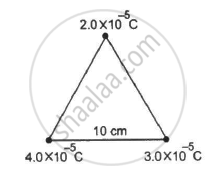
Define a unit charge.
Write a short note on superposition principle.
The S.I unit of electric permittivity is
Two charges q and – 3q are placed fixed on x-axis separated by distance ‘d’. Where should a third charge 2q be placed such that it will not experience any force?
There is another useful system of units, besides the SI/mks A system, called the cgs (centimeter-gram-second) system. In this system Coloumb’s law is given by
F = `(Qq)/r^2 hatr`
where the distance r is measured in cm (= 10–2 m), F in dynes (= 10–5 N) and the charges in electrostatic units (es units), where 1 es unit of charge = `1/([3]) xx 10^-9 C`
The number [3] actually arises from the speed of light in vaccum which is now taken to be exactly given by c = 2.99792458 × 10⁸ m/s. An approximate value of c then is c = [3] × 108 m/s.
(i) Show that the coloumb law in cgs units yields
1 esu of charge = 1 (dyne)1/2 cm.
Obtain the dimensions of units of charge in terms of mass M, length L and time T. Show that it is given in terms of fractional powers of M and L.
(ii) Write 1 esu of charge = x C, where x is a dimensionless number. Show that this gives
`1/(4pi ∈_0) = 10^-9/x^2 (N*m^2)/C^2`
With `x = 1/([3]) xx 10^-9`, we have `1/(4pi ∈_0) = [3]^2 xx 10^9 (Nm^2)/C^2`
or, `1/(4pi ∈_0) = (2.99792458)^2 xx 10^9 (Nm^2)/C^2` (exactly).
Two point charges Q each are placed at a distance d apart. A third point charge q is placed at a distance x from the mid-point on the perpendicular bisector. The value of x at which charge q will experience the maximum Coulomb's force is ______.
Four charges equal to −Q are placed at the four a corners of a square and charge q is at its centre. If the system is in equilibrium, the value of q is ______.
