Advertisements
Advertisements
Question
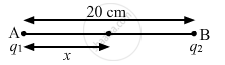
Two particles A and B possessing charges of +2.00 × 10⁻⁶ C and of −4.00 × 10⁻⁶ C, respectively, are held fixed at a separation of 20.0 cm. Locate the points (s) on the line AB, where (a) the electric field is zero (b) the electric potential is zero.
Advertisements
Solution
Given:
Magnitude of the charges,
\[q_1 = 2 . 0 \times {10}^{- 6} C\] and
\[q_2 = - 4 . 0 \times {10}^{- 6} C\]
Separation between the charges, r = 0.2 m
(a) Let the electric field be zero at a distance x from A, as shown in the figure.
Then,
\[\frac{1}{4\pi \epsilon_0}\frac{q_1}{x^2} + \frac{1}{4\pi \epsilon_0}\frac{q_2}{\left( 0 . 2 - x \right)^2} = 0\]
\[ \Rightarrow \frac{2}{x^2} + \frac{- 4}{\left( 0 . 2 + x \right)^2} = 0\]
or x = 48.3 cm from A along BA.
(b) Let the potential be zero at a distance x from A.
\[\frac{1}{4\pi \epsilon_0}\frac{q_1}{x} + \frac{1}{4\pi \epsilon_0}\frac{q_2}{\left( 0 . 2 - x \right)} = 0\]
\[ \Rightarrow \frac{2}{x} - \frac{-4}{\left( 0 . 2- x \right)} = 0\]
\[\text{ Or } \frac{1}{x} = \frac{2}{\left( 0 . 2 - x \right)}\]
\[ \Rightarrow 0 . 2 - x = 2x\]
= 2x = 2.20 - x
= 3x = 0.20
= `x = 0.20/3`
APPEARS IN
RELATED QUESTIONS
- Two insulated charged copper spheres A and B have their centers separated by a distance of 50 cm. What is the mutual force of electrostatic repulsion if the charge on each is 6.5 × 10⁻⁷ C? The radii of A and B are negligible compared to the distance of separation.
- What is the force of repulsion if each sphere is charged double the above amount, and the distance between them is halved?
Write any two important points of similarities and differences each between Coulomb's law for the electrostatic field and Biot-Savart's law of the magnetic field ?
Does the force on a charge due to another charge depend on the charges present nearby?
Two equal charges are placed at a separation of 1.0 m. What should be the magnitude of the charges, so that the force between them equals the weight of a 50 kg person?
Suppose the second charge in the previous problem is −1.0 × 10⁻⁶ C. Locate the position where a third charge will not experience a net force.
Two insulating small spheres are rubbed against each other and placed 1 cm apart. If they attract each other with a force of 0.1 N, how many electrons were transferred from one sphere to the other during rubbing?
Find the ratio of the electrical and gravitational forces between two protons.
Suppose an attractive nuclear force acts between two protons which may be written as F=Ce−kr/r2. Suppose that k = 1 fermi−1 and that the repulsive electric force between the protons is just balanced by the attractive nuclear force when the separation is 5 fermi. Find the value of C.
A hydrogen atom contains one proton and one electron. It may be assumed that the electron revolves in a circle of radius 0.53 angstrom (1 angstrom = 10−10 m and is abbreviated as Å ) with the proton at the centre. The hydrogen atom is said to be in the ground state in this case. Find the magnitude of the electric force between the proton and the electron of a hydrogen atom in its ground state.
Ten positively-charged particles are kept fixed on the x-axis at points x = 10 cm, 20 cm, 30 cm, ...., 100 cm. the first particle has a charge 1.0 × 10⁻⁸ C, the second 8 × 10⁻⁸ C, the third 27 × 10−8 C and so on. The tenth particle has a charge 1000 × 10−8 C. Find the magnitude of the electric force acting on a 1 C charge placed at the origin.
A particle with a charge of 2.0 × 10⁻⁴ C is placed directly below and at a separation of 10 cm from the bob of a simple pendulum at rest. The mass of the bob is 100 g. What charge should the bob be given so that the string becomes loose?
Two particles A and B, each carrying a charge Q, are held fixed with a separation dbetween them. A particle C of mass m and charge q is kept at the middle point of the line AB. If it is displaced through a distance x perpendicular to AB, what would be the electric force experienced by it?
Two point charges +3 µC and +8 µC repel each other with a force of 40 N. If a charge of -5 µC is added to each of them, then force between them will become ______.
Electric charge of any system is ______.
Two charges q and – 3q are placed fixed on x-axis separated by distance ‘d’. Where should a third charge 2q be placed such that it will not experience any force?
Which of the following statements about nuclear forces is not true?
What is meant by the statement: "Relative permittivity of water is 81"?
