हिंदी
कर्नाटक बोर्ड पी.यू.सी.पीयूसी विज्ञान कक्षा ११

Three Equal Charges, 2.0 × 10⁻⁶ C Each, Are Held at the Three Corners of an Equilateral Triangle of Side 5 Cm. Find the Coulomb Force Experienced by One of the Charges Due to the Other Two. - Physics

Advertisements
Advertisements

प्रश्न

Three equal charges, 2.0 × 106 C each, are held at the three corners of an equilateral triangle of side 5 cm. Find the Coulomb force experienced by one of the charges due to the other two.  

टिप्पणी लिखिए
Advertisements

उत्तर

Since all the charges are of equal magnitude, the force on the charge at A due to the charges at B and C will be of equal magnitude. (As shown in the figure) 

That is,
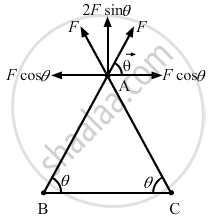
\[F_{BA}  =  F_{CA}  = F\left( \text{ say } \right)\]


The horizontal components of force cancel each other and the net force on the charge at A,

\[F' =  F_{BA} \sin\theta +  F_{CA} \sin\theta\] 

\[F' = 2F\sin\theta  \] 

Given: r = 5 cm =0.05 m
By Coulomb's Law, force, 

\[F = \frac{1}{4\pi \epsilon_0}\frac{q_1 q_2}{r^2}\]

\[F' = \frac{2 \times 9 \times {10}^9 \times \left( 2 \times {10}^{- 6} \right)^2 \times \sin60^\circ}{\left( 0 . 05 \right)^2}\] 

\[F' = \frac{2 \times 9 \times {10}^9 \times \left( 2 \times {10}^{- 6} \right)^2 \times \frac{\sqrt{3}}{2}}{\left( 0 . 05 \right)^2}\]

F' = 24.9 N

 
shaalaa.com
  क्या इस प्रश्न या उत्तर में कोई त्रुटि है?
अध्याय 7: Electric Field and Potential - Exercises [पृष्ठ १२१]

APPEARS IN

एचसी वर्मा Concepts of Physics Vol. 2 [English] Class 11 and 12
अध्याय 7 Electric Field and Potential
Exercises | Q 16 | पृष्ठ १२१

संबंधित प्रश्न

  1. Two insulated charged copper spheres A and B have their centers separated by a distance of 50 cm. What is the mutual force of electrostatic repulsion if the charge on each is 6.5 × 10⁻⁷ C? The radii of A and B are negligible compared to the distance of separation.
  2. What is the force of repulsion if each sphere is charged double the above amount, and the distance between them is halved?

Does the force on a charge due to another charge depend on the charges present nearby?


Two charges 2.0 × 10⁻⁶ C and 1.0 × 10⁻⁶ C are placed at a separation of 10 cm. Where should a third charge be placed, such that it experiences no net force due to these charges?


Suppose the second charge in the previous problem is −1.0 × 10⁶ C. Locate the position where a third charge will not experience a net force. 


Suppose all the electrons of 100 g water are lumped together to form a negatively-charged particle and all the nuclei are lumped together to form a positively-charged particle. If these two particles are placed 10.0 cm away from each other, find the force of attraction between them. Compare it with your weight.


A particle with a charge of 2.0 × 10⁻⁴ C is placed directly below and at a separation of 10 cm from the bob of a simple pendulum at rest. The mass of the bob is 100 g. What charge should the bob be given so that the string becomes loose? 


Two identically-charged particles are fastened to the two ends of a spring of spring constant 100 N m−1 and natural length 10 cm. The system rests on a smooth horizontal table. If the charge on each particle is 2.0 × 10⁻⁸ C, find the extension in the length of the spring. Assume that the extension is small as compared to the natural length. Justify this assumption after you solve the problem.  


A particle A with a charge of 2.0 × 10⁻⁶ C is held fixed on a horizontal table. A second charged particle of mass 80 g stays in equilibrium on the table at a distance of 10 cm from the first charge. The coefficient of friction between the table and this second particle is μ = 0.2. Find the range within which the charge of this second particle may lie.


Two particles A and B possessing charges of +2.00 × 10⁻⁶ C and of −4.00 × 10⁻⁶ C, respectively, are held fixed at a separation of 20.0 cm. Locate the points (s) on the line AB, where (a) the electric field is zero (b) the electric potential is zero.  


Two equal charges, 2.0 × 10⁻⁷ C each, are held fixed at a separation of 20 cm. A third charge of equal magnitude is placed midway between the two charges. It is now moved to a point 20 cm from both the charges. How much work is done by the electric field during the process?


Two particles of masses 5.0 g each and opposite charges of +4.0 × 10⁻⁵ C and −4.0 × 10⁻⁵ C are released from rest with a separation of 1.0 m between them. Find the speeds of the particles when the separation is reduced to 50 cm.  


Solve numerical example.

Three equal charges of 10×10-8 C respectively, each located at the corners of a right triangle whose sides are 15 cm, 20 cm, and 25cm respectively. Find the force exerted on the charge located at the 90° angle.


What are the differences between the Coulomb force and the gravitational force?


Two identical thin rings, each of radius a meter, are coaxially placed at a distance R meter apart. If Q1 coulomb and Q2 coulomb are respectively the charges uniformly spread on the two rings, the work done in moving a charge q coulomb from the centre of one ring to that of the other is ______.


SI unit of permittivity of free space is ______.


A spring of spring constant 5 × 10³ N/m is stretched initially by 5 cm from the unstretched position. Then the work required to stretch it further by another 5 cm is:


Two point charges +2 C and +6 C repel each other with a force of 12 N. If a charge of -4 C is given to each of these charges, then the force now is ______.


What is meant by the statement: "Relative permittivity of water is 81"?


Share
Notifications

Englishहिंदीमराठी


      Forgot password?
Use app×