Advertisements
Advertisements
प्रश्न
Four equal charges of 2.0 × 10⁻⁶ C each are fixed at the four corners of a square of side 5 cm. Find the Coulomb's force experienced by one of the charges due to the other three.
Advertisements
उत्तर
Given,
Magnitude of the charges,
\[q = 2 \times {10}^{- 6} C\] Side of the square,
\[a = 5 \text{ cm = 0 . 05 m }\]
By Coulomb's Law, force,
\[F = \frac{1}{4\pi \epsilon_0}\frac{q_1 q_2}{r^2}\]
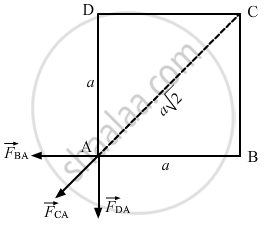
So, force on the charge at A due to the charge at B,
\[\vec{F}_{BA} = \frac{9 \times {10}^9 \times \left( 2 \times {10}^{- 6} \right)^2}{\left( 0 . 05 \right)^2} \]
\[ = \frac{9 \times {10}^9 \times 4 \times {10}^{- 12}}{25 \times {10}^{- 4}}\]
\[ = 14 . 4 N\]
Force on the charge at A due to the charge at C,
\[\vec{F}_{CA} = \frac{9 \times {10}^9 \times \left( 2 \times {10}^{- 6} \right)^2}{\left( \sqrt{2} \times 0 . 05 \right)^2}\]
\[ = \frac{9 \times {10}^9 \times 4 \times {10}^{- 12}}{25 \times 2 \times {10}^{- 4}}\]
\[ = 7 . 2 N\]
Force on the charge at A due to the charge at D,
\[\vec{F}_{DA} = \vec{F}_{BA}\]
The resultant force at A, F'= \[\vec{F}_{BA} + \vec{F}_{CA} + \vec{F}_{DA}\]
The resultant force of \[\vec{F}_{DA} \text{ and } \vec{F}_{BA}\] will be \[\sqrt{2} F_{BA}\] in the direction of \[\vec{F}_{CA}\] . Hence, the resultant force,
\[F' = 14 . 4\sqrt{2} + 7 . 2\]
\[ = 27 . 56 N\]
APPEARS IN
संबंधित प्रश्न
A particle of mass m and charge (−q) enters the region between the two charged plates initially moving along x-axis with speed vx (like particle 1 in the fig.). The length of plate is L and an uniform electric field E is maintained between the plates. Show that the vertical deflection of the particle at the far edge of the plate is qEL2/(2m`"v"_"x"^2`).

Two charges 2.0 × 10⁻⁶ C and 1.0 × 10⁻⁶ C are placed at a separation of 10 cm. Where should a third charge be placed, such that it experiences no net force due to these charges?
Two insulating small spheres are rubbed against each other and placed 1 cm apart. If they attract each other with a force of 0.1 N, how many electrons were transferred from one sphere to the other during rubbing?
NaCl molecule is bound due to the electric force between the sodium and the chlorine ions when one electron of sodium is transferred to chlorine. Taking the separation between the ions to be 2.75 × 10⁻⁸ cm, find the force of attraction between them. State the assumptions (if any) that you have made.
Suppose an attractive nuclear force acts between two protons which may be written as F=Ce−kr/r2. Write down the dimensional formulae and appropriate SI units of C and k.
Suppose an attractive nuclear force acts between two protons which may be written as F=Ce−kr/r2. Suppose that k = 1 fermi−1 and that the repulsive electric force between the protons is just balanced by the attractive nuclear force when the separation is 5 fermi. Find the value of C.
Two small spheres, each with a mass of 20 g, are suspended from a common point by two insulating strings of length 40 cm each. The spheres are identically charged and the separation between the balls at equilibrium is found to be 4 cm. Find the charge on each sphere.
A particle A with a charge of 2.0 × 10⁻⁶ C is held fixed on a horizontal table. A second charged particle of mass 80 g stays in equilibrium on the table at a distance of 10 cm from the first charge. The coefficient of friction between the table and this second particle is μ = 0.2. Find the range within which the charge of this second particle may lie.
Three identical charges, each with a value of 1.0 × 10⁻⁸ C, are placed at the corners of an equilateral triangle of side 20 cm. Find the electric field and potential at the centre of the triangle.
Define a unit charge.
What are the differences between the Coulomb force and the gravitational force?
Polarised dielectric is equivalent to ______.
The unit of charge is ______.
Coulomb's law is given by F = k q1q2 rn where n is
The S.I unit of electric permittivity is
Identify the wrong statement in the following.
Coulomb's law correctly describes the electric force that ______.
Electric charge of any system is ______.
The ratio of the forces between two charges placed at a certain distance apart in the air and by the same distance apart in a medium of dielectric constant K is ______.
