English
Karnataka Board PUCPUC Science Class 11

Four Equal Charges of 2.0 × 10⁻⁶ C Each Are Fixed at the Four Corners of a Square of Side 5 Cm. Find the Coulomb'S Force Experienced by One of the Charges Due to the Other Three. - Physics

Advertisements
Advertisements

Question

Four equal charges of 2.0 × 10⁻⁶ C each are fixed at the four corners of a square of side 5 cm. Find the Coulomb's force experienced by one of the charges due to the other three. 

Short/Brief Note
Advertisements

Solution

Given,
Magnitude of the charges, 

\[q = 2 \times  {10}^{- 6}   C\] Side of the square,

\[a = 5  \text{ cm = 0 . 05  m }\]

By Coulomb's Law, force, 

\[F = \frac{1}{4\pi \epsilon_0}\frac{q_1 q_2}{r^2}\]     
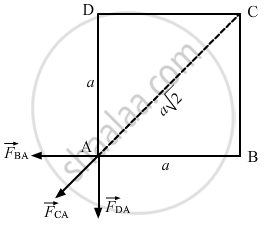
  

So, force on the charge at A due to the charge at B,

\[\vec{F}_{BA}  = \frac{9 \times {10}^9 \times \left( 2 \times {10}^{- 6} \right)^2}{\left( 0 . 05 \right)^2}      \]  

\[             = \frac{9 \times {10}^9 \times 4 \times {10}^{- 12}}{25 \times {10}^{- 4}}\] 

\[             = 14 . 4  N\] 

Force on the charge at A due to the charge at C,

\[\vec{F}_{CA}  = \frac{9 \times {10}^9 \times \left( 2 \times {10}^{- 6} \right)^2}{\left( \sqrt{2} \times 0 . 05 \right)^2}\] 

\[             = \frac{9 \times {10}^9 \times 4 \times {10}^{- 12}}{25 \times 2 \times {10}^{- 4}}\] 

\[             = 7 . 2  N\] 

Force on the charge at A due to the charge at D,

\[\vec{F}_{DA}  =  \vec{F}_{BA}\]

The resultant force at A, F'= \[\vec{F}_{BA}  +  \vec{F}_{CA}  +  \vec{F}_{DA}\]

The resultant force of \[\vec{F}_{DA}  \text{ and  } \vec{F}_{BA}\]  will be \[\sqrt{2} F_{BA}\]  in the direction of \[\vec{F}_{CA}\] . Hence, the resultant force,

\[F' = 14 . 4\sqrt{2} + 7 . 2\] 

\[       = 27 . 56  N\]

shaalaa.com
  Is there an error in this question or solution?
Chapter 7: Electric Field and Potential - Exercises [Page 121]

APPEARS IN

HC Verma Concepts of Physics Vol. 2 [English] Class 11 and 12
Chapter 7 Electric Field and Potential
Exercises | Q 17 | Page 121

RELATED QUESTIONS

Two equal balls with equal positive charge 'q' coulombs are suspended by two insulating strings of equal length. What would be the effect on the force when a plastic sheet is inserted between the two?


A particle of mass m and charge (−q) enters the region between the two charged plates initially moving along x-axis with speed vx (like particle 1 in the fig.). The length of plate is L and an uniform electric field E is maintained between the plates. Show that the vertical deflection of the particle at the far edge of the plate is qEL2/(2m`"v"_"x"^2`).


Does the force on a charge due to another charge depend on the charges present nearby?


At what separation should two equal charges, 1.0 C each, be placed, so that the force between them equals the weight of a 50 kg person? 


Consider a gold nucleus to be a sphere of radius 6.9 fermi in which protons and neutrons are distributed. Find the force of repulsion between two protons situated at largest separation. Why do these protons not fly apart under this repulsion?


Suppose an attractive nuclear force acts between two protons which may be written as F=Ce−kr/r2. Write down the dimensional formulae and appropriate SI units of C and k.   


Suppose an attractive nuclear force acts between two protons which may be written as F=Ce−kr/r2. Suppose that k = 1 fermi−1 and that the repulsive electric force between the protons is just balanced by the attractive nuclear force when the separation is 5 fermi. Find the value of C. 


A hydrogen atom contains one proton and one electron. It may be assumed that the electron revolves in a circle of radius 0.53 angstrom (1 angstrom = 10−10 m and is abbreviated as Å ) with the proton at the centre. The hydrogen atom is said to be in the ground state in this case. Find the magnitude of the electric force between the proton and the electron of a hydrogen atom in its ground state.


Ten positively-charged particles are kept fixed on the x-axis at points x = 10 cm, 20 cm, 30 cm, ...., 100 cm. the first particle has a charge 1.0 × 10⁻⁸ C, the second 8 × 10⁻⁸ C, the third 27 × 10−8 C and so on. The tenth particle has a charge 1000 × 10−8 C.  Find the magnitude of the electric force acting on a 1 C charge placed at the origin. 


Two charged particles with charge 2.0 × 10⁻⁸ C each are joined by an insulating string of length 1 m and the system is kept on a smooth horizontal table. Find the tension in the string.


Two identical pith balls are charged by rubbing one against the other. They are suspended from a horizontal rod through two strings of length 20 cm each, the separation between the suspension points being 5 cm. In equilibrium, the separation between the balls is 3 cm. Find the mass of each ball and the tension in the strings. The charge on each ball has a magnitude 2.0 × 10⁻⁸ C.


Two charged particles, with equal charges of 2.0 × 10⁻⁵ C, are brought from infinity to within a separation of 10 cm. Find the increase in the electric potential energy during the process 


Three charges +Q, q, +Q are placed respectively, at distance, 0, d/2 and d from the origin, on the X-axis. If the net force experienced by +Q, placed at x = 0, is zero then value of q is ____________.


A total charge Q is broken in two parts Q1 and Q2 and they are placed at a distance R from each other. The maximum force of repulsion between them will occur, when ____________.


Polarised dielectric is equivalent to ______.


The law, governing the force between electric charges is known as ______.

Coulomb's law is given by F = k q1q2 rn where n is 


Two point charges +2 C and +6 C repel each other with a force of 12 N. If a charge of -4 C is given to each of these charges, then the force now is ______.


What is meant by the statement: "Relative permittivity of water is 81"?


Share
Notifications

Englishहिंदीमराठी


      Forgot password?
Use app×