Advertisements
Advertisements
प्रश्न
Four equal charges of 2.0 × 10⁻⁶ C each are fixed at the four corners of a square of side 5 cm. Find the Coulomb's force experienced by one of the charges due to the other three.
Advertisements
उत्तर
Given,
Magnitude of the charges,
\[q = 2 \times {10}^{- 6} C\] Side of the square,
\[a = 5 \text{ cm = 0 . 05 m }\]
By Coulomb's Law, force,
\[F = \frac{1}{4\pi \epsilon_0}\frac{q_1 q_2}{r^2}\]
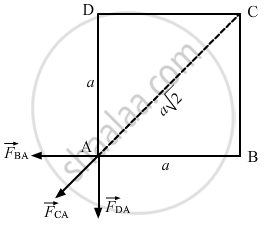
So, force on the charge at A due to the charge at B,
\[\vec{F}_{BA} = \frac{9 \times {10}^9 \times \left( 2 \times {10}^{- 6} \right)^2}{\left( 0 . 05 \right)^2} \]
\[ = \frac{9 \times {10}^9 \times 4 \times {10}^{- 12}}{25 \times {10}^{- 4}}\]
\[ = 14 . 4 N\]
Force on the charge at A due to the charge at C,
\[\vec{F}_{CA} = \frac{9 \times {10}^9 \times \left( 2 \times {10}^{- 6} \right)^2}{\left( \sqrt{2} \times 0 . 05 \right)^2}\]
\[ = \frac{9 \times {10}^9 \times 4 \times {10}^{- 12}}{25 \times 2 \times {10}^{- 4}}\]
\[ = 7 . 2 N\]
Force on the charge at A due to the charge at D,
\[\vec{F}_{DA} = \vec{F}_{BA}\]
The resultant force at A, F'= \[\vec{F}_{BA} + \vec{F}_{CA} + \vec{F}_{DA}\]
The resultant force of \[\vec{F}_{DA} \text{ and } \vec{F}_{BA}\] will be \[\sqrt{2} F_{BA}\] in the direction of \[\vec{F}_{CA}\] . Hence, the resultant force,
\[F' = 14 . 4\sqrt{2} + 7 . 2\]
\[ = 27 . 56 N\]
APPEARS IN
संबंधित प्रश्न
Four point charges qA = 2 μC, qB = −5 μC, qC = 2 μC, and qD = −5 μC are located at the corners of a square ABCD of side 10 cm. What is the force on a charge of 1 μC placed at the centre of the square?
Suppose that the particle is an electron projected with velocity vx = 2.0 × 10⁶ m s−1. If E between the plates separated by 0.5 cm is 9.1 × 10² N/C, where will the electron strike the upper plate? (|e| = 1.6 × 10⁻¹⁹ C, me = 9.1 × 10⁻³¹ kg)
Does the force on a charge due to another charge depend on the charges present nearby?
Find the dimensional formula of ε0.
Two charges 2.0 × 10⁻⁶ C and 1.0 × 10⁻⁶ C are placed at a separation of 10 cm. Where should a third charge be placed, such that it experiences no net force due to these charges?
Suppose the second charge in the previous problem is −1.0 × 10⁻⁶ C. Locate the position where a third charge will not experience a net force.
Estimate the number of electrons in 100 g of water. How much is the total negative charge on these electrons?
Two insulating small spheres are rubbed against each other and placed 1 cm apart. If they attract each other with a force of 0.1 N, how many electrons were transferred from one sphere to the other during rubbing?
Find the ratio of the electrical and gravitational forces between two protons.
Two identical pith balls are charged by rubbing one against the other. They are suspended from a horizontal rod through two strings of length 20 cm each, the separation between the suspension points being 5 cm. In equilibrium, the separation between the balls is 3 cm. Find the mass of each ball and the tension in the strings. The charge on each ball has a magnitude 2.0 × 10⁻⁸ C.
Define a unit charge.
A total charge Q is broken in two parts Q1 and Q2 and they are placed at a distance R from each other. The maximum force of repulsion between them will occur, when ____________.
Two positive charges ______.
Four equal charges q are placed at the four comers A, B, C, D of a square of length a. The magnitude of the force on the charge at B will be ______.

Two charges of equal magnitudes kept at a distance r exert a force F on each other. If the charges are halved and distance between them is doubled, then the new force acting on each charge is ______.
Electric charge of any system is ______.
There is another useful system of units, besides the SI/mks A system, called the cgs (centimeter-gram-second) system. In this system Coloumb’s law is given by
F = `(Qq)/r^2 hatr`
where the distance r is measured in cm (= 10–2 m), F in dynes (= 10–5 N) and the charges in electrostatic units (es units), where 1 es unit of charge = `1/([3]) xx 10^-9 C`
The number [3] actually arises from the speed of light in vaccum which is now taken to be exactly given by c = 2.99792458 × 10⁸ m/s. An approximate value of c then is c = [3] × 108 m/s.
(i) Show that the coloumb law in cgs units yields
1 esu of charge = 1 (dyne)1/2 cm.
Obtain the dimensions of units of charge in terms of mass M, length L and time T. Show that it is given in terms of fractional powers of M and L.
(ii) Write 1 esu of charge = x C, where x is a dimensionless number. Show that this gives
`1/(4pi ∈_0) = 10^-9/x^2 (N*m^2)/C^2`
With `x = 1/([3]) xx 10^-9`, we have `1/(4pi ∈_0) = [3]^2 xx 10^9 (Nm^2)/C^2`
or, `1/(4pi ∈_0) = (2.99792458)^2 xx 10^9 (Nm^2)/C^2` (exactly).
Which of the following statements about nuclear forces is not true?
Four charges equal to −Q are placed at the four a corners of a square and charge q is at its centre. If the system is in equilibrium, the value of q is ______.
